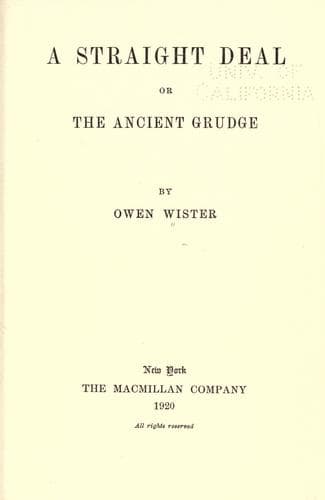
A Straight Deal; Or, The Ancient GrudgeWister, Owen
History
A Straight Deal; Or, The Ancient Grudge
Wister, Owen
Great Britain -- Relations -- United States; United States -- Relations -- Great Britain
They made other similar remarks; commented unfavorably upon the
alignment; “You were a bit late in coming,” they said. Of course our
boys had answers, and to these the Tommies had further answers, and
this encounter of wits very naturally led to a result which could not
possibly have been happier. I don’t know what the Tommies expected the
Yankees to do. I suppose they were as ignorant of our nature as we of
theirs, and that they entertained preconceived notions. They suddenly
found that we were, once again to quote Mr. Kipling, “bachelors in
barricks most remarkable like” themselves. An American first sergeant
hit a British first sergeant. Instantly a thousand men were milling. For
thirty minutes they kept at it. Warriors reeled together and fell and
rose and got it in the neck and the jaw and the eye and the nose--and
all the while the British and American officers, splendidly discreet,
saw none of it. British soldiers were carried back to their streets,
still fighting, bunged Yankees staggered everywhere--but not an officer
saw any of it. Black eyes the next day, and other tokens, very plainly
showed who had been at this party. Thereafter a much better feeling
prevailed between Tommies and Yanks.
A more peaceful contact produced excellent consequences at an encampment
of Americans in England. The Americans had brought over an idea,
apparently, that the English were “easy.” They tried it on in sundry
ways, but ended by the discovery that, while engaged upon this
enterprise, they had been in sundry ways quite completely “done”
themselves. This gave them a respect for their English cousins which
they had never felt before.
Here is another tale, similar in moral. This occurred at Brest, in
France. In the Y hut sat an English lady, one of the hostesses. To
her came a young American marine with whom she already had some
acquaintance. This led him to ask for her advice. He said to her that
as his permission was of only seventy-two hours, he wanted to be as
economical of his time as he could and see everything best worth while
for him to see during his leave. Would she, therefore, tell him what
things in Paris were the most interesting and in what order he had best
take them? She replied with another suggestion; why not, she said, ask
for permission for England? This would give him two weeks instead of
seventy-two hours. At this he burst out violently that he would not
set foot in England; that he never wanted to have anything to do with
England or with the English: “Why, I am a marine!” he exclaimed, “and we
marines would sooner knock down any English sailor than speak to him.”
Public-domain text, read in full here on John Shaqi.
Reviews
Reviews
No reviews yet
Be the first to share your thoughts on this work.
Elsewhere in the archive
Join the Discussion
Join the discussion
Sign in to leave a comment or review.
Sign InorCreate an account