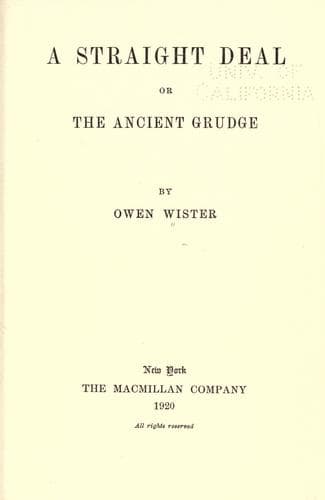
A Straight Deal; Or, The Ancient GrudgeWister, Owen
History
A Straight Deal; Or, The Ancient Grudge
Wister, Owen
Great Britain -- Relations -- United States; United States -- Relations -- Great Britain
The English lady, naturally, did not then tell him her nationality. She
now realized that he had supposed her to be American, because she had
frequently been in America and had talked to him as no stranger to the
country could. She, of course, did not urge his going to England; she
advised him what to see in France. He took his leave of seventy-two
hours and when he returned was very grateful for the advice she had
given him.
She saw him often after this, and he grew to rely very much upon her
friendly counsel. Finally, when the time came for her to go away from
Brest, she told him that she was English. And then she said something
like this to him:
“Now, you told me you had never been in England and had never known an
English person in your life, and yet you had all these ideas against us
because somebody had taught you wrong. It is not at all your fault. You
are only nineteen years old and you cannot read about us, because you
have no chance; but at least you do know one English person now, and
that English person begs you, when you do have a chance to read and
inform yourself of the truth, to find out what England really has been,
and what she has really done in this war.”
The end of the story is that the boy, who had become devoted to her, did
as she suggested. To-day she receives letters from him which show that
nothing is left of his anti-English complex. It is another instance of
how clearly our native American mind, if only the facts are given it,
thinks, judges, and concludes.
It is for those of my countrymen who will never have this chance,
never meet some one who can “guide them to the facts”, that I tell
these things. Let them “cut out the dope.” At this very moment that I
write--November 24, 1919--the dope is being fed freely to all who are
ready, whether through ignorance or through interested motives, to
swallow it. The ancient grudge is being played up strong over the whole
country in the interest of Irish independence.
Ian Hay in his two books so timely and so excellent, Getting Together
and The Oppressed English, could not be as unreserved, naturally, as I
can be about those traits in my own countrymen which have, in the past
at any rate, retarded English cordiality towards Americans. Of these I
shall speak as plainly as I know how. But also, being an American
and therefore by birth more indiscreet than Ian Hay, I shall speak as
plainly as I know how of those traits in the English which have helped
to keep warm our ancient grudge. Thus I may render both countries
forever uninhabitable to me, but shall at least take with me into exile
a character for strict, if disastrous, impartiality.
I begin with an American who was traveling in an English train. It
stopped somewhere, and out of the window he saw some buildings which
interested him.
“Can you tell me what those are?” he asked an Englishman, a stranger,
who sat in the other corner of the compartment.
“Better ask the guard,” said the Englishman.
Public-domain text, read in full here on John Shaqi.
Reviews
Reviews
No reviews yet
Be the first to share your thoughts on this work.
Elsewhere in the archive
Join the Discussion
Join the discussion
Sign in to leave a comment or review.
Sign InorCreate an account