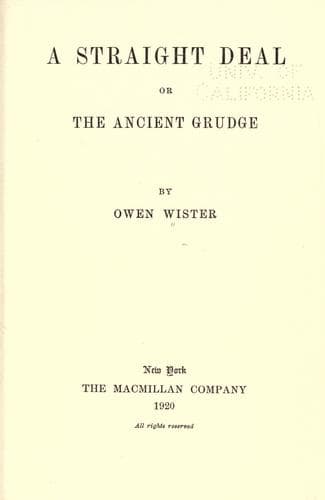
A Straight Deal; Or, The Ancient GrudgeWister, Owen
History
A Straight Deal; Or, The Ancient Grudge
Wister, Owen
Great Britain -- Relations -- United States; United States -- Relations -- Great Britain
“Why do you call your baggage luggage?” says the American--or used to
say.
“Why don’t you say treacle?” inquires the Englishman.
“Because we call it molasses,” answers the American.
“How absurd to speak of a car when you mean a carriage!” exclaims the
Englishman.
“We don’t mean a carriage, we mean a car,” retorts the American.
You, my reader, may have heard (or perhaps even held) foolish
conversations like that; and you will readily perceive that if we didn’t
say “car” when we spoke of the vehicle you get into when you board a
train, but called it a voiture, or something else quite “foreign,” the
Englishman would not feel that we had taken a sort of liberty with his
mother-tongue. A deep point lies here: for most English the world is
divided into three peoples, English, foreigners, and Americans; and
for most of us likewise it is divided into Americans, foreigners, and
English. Now a “foreigner” can call molasses whatever he pleases; we
do not feel that he has taken any liberty with our mother-tongue;
his tongue has a different mother; he can’t help that; he’s not to be
criticized for that. But we and the English speak a tongue that has
the same mother. This identity in pedigree has led and still leads
to countless family discords. I’ve not a doubt that divergences in
vocabulary and in accent were the fount and origin of some swollen
noses, some battered eyes, when our Yankees mixed with the Tommies. Each
would be certain to think that the other couldn’t “talk straight”--and
each would be certain to say so. I shall not here spin out a list of
different names for the same things now current in English and American
usage: molasses and treacle will suffice for an example; you will be
able easily to think of others, and there are many such that occur in
everyday speech. Almost more tricky are those words which both peoples
use alike, but with different meanings. I shall spin no list of
these either; one example there is which I cannot name, of two words
constantly used in both countries, each word quite proper in one
country, while in the other it is more than improper. Thirty years ago
I explained this one evening to a young Englishman who was here for a
while. Two or three days later, he thanked me fervently for the warning:
it had saved him, during a game of tennis, from a frightful shock, when
his partner, a charming girl, meaning to tell him to cheer up, had used
the word that is so harmless with us and in England so far beyond the
pale of polite society.
Quite as much as words, accent also leads to dissension. I have heard
many an American speak of the English accent as “affected”; and our
accent displeases the English. Now what Englishman, or what American,
ever criticizes a Frenchman for not pronouncing our language as we do?
His tongue has a different mother!
Public-domain text, read in full here on John Shaqi.
Reviews
Reviews
No reviews yet
Be the first to share your thoughts on this work.
Elsewhere in the archive
Join the Discussion
Join the discussion
Sign in to leave a comment or review.
Sign InorCreate an account