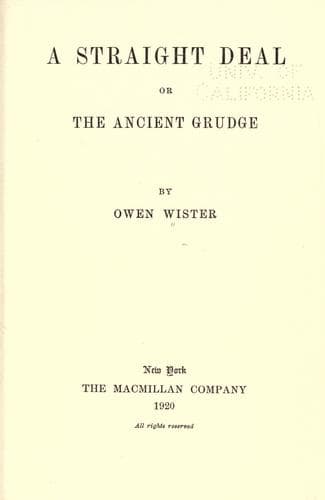
A Straight Deal; Or, The Ancient GrudgeWister, Owen
History
A Straight Deal; Or, The Ancient Grudge
Wister, Owen
Great Britain -- Relations -- United States; United States -- Relations -- Great Britain
“Oh, I see,” said the Bostonian, “that you haven’t your dress suit with
you. The man will take you upstairs and one of mine will fit you well
enough. We’ll wait.”
In England, a cricketer from Philadelphia, after the match at Lord’s,
had been invited to dine at a great house with the rest of his eleven.
They were to go there on a coach. The American discovered after arrival
that he alone of the eleven had not brought a dress suit with him. He
asked his host what he was to do.
“I advise you to go home,” said the host.
The moral here is not that all hosts in England would have treated a
guest so, or that all American hosts would have met the situation so
well as that Boston gentleman: but too many English used to be socially
brutal--quite as much so to each other as to us, or any one. One should
bear that in mind. I know of nothing more English in its way than what
Eton answered to Beaumont (I think) when Beaumont sent a challenge to
play cricket: “Harrow we know, and Rugby we have heard of. But who are
you?”
That sort of thing belongs rather to the Palmerston days than to these;
belongs to days that were nearer in spirit to the Waterloo of 1815,
which a haughty England won, than to the Waterloo of 1914-18, which a
humbler England so nearly lost.
Turn we next the other way for a look at ourselves. An American lady who
had brought a letter of introduction to an Englishman in London was in
consequence asked to lunch. He naturally and hospitably gathered to
meet her various distinguished guests. Afterwards she wrote him that
she wished him to invite her to lunch again, as she had matters of
importance to tell him. Why, then, didn’t she ask him to lunch with her?
Can you see? I think I do.
An American lady was at a house party in Scotland at which she met a
gentleman of old and famous Scotch blood. He was wearing the kilt of
his clan. While she talked with him she stared, and finally burst out
laughing. “I declare,” she said, “that’s positively the most ridiculous
thing I ever saw a man dressed in.”
At the Savoy hotel in August, 1914, when England declared war upon
Germany, many American women made scenes of confusion and vociferation.
About England and the blast of Fate which had struck her they had
nothing to say, but crowded and wailed of their own discomforts, meals,
rooms, every paltry personal inconvenience to which they were subjected,
or feared that they were going to be subjected. Under the unprecedented
stress this was, perhaps, not unnatural; but it would have seemed less
displeasing had they also occasionally showed concern for England’s
plight and peril.
An American, this time a man (our crudities are not limited to the sex)
stood up in a theatre, disputing the sixpence which you always have to
pay for your program in the London theatres. He disputed so long that
many people had to stand waiting to be shown their seats.
Public-domain text, read in full here on John Shaqi.
Reviews
Reviews
No reviews yet
Be the first to share your thoughts on this work.
Elsewhere in the archive
Join the Discussion
Join the discussion
Sign in to leave a comment or review.
Sign InorCreate an account