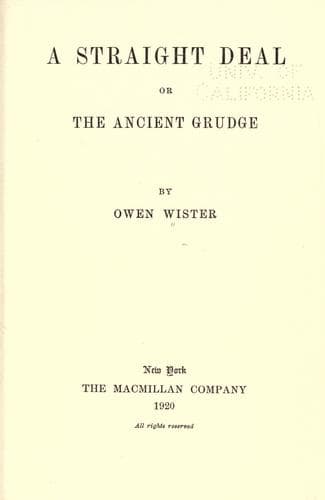
A Straight Deal; Or, The Ancient GrudgeWister, Owen
History
A Straight Deal; Or, The Ancient Grudge
Wister, Owen
Great Britain -- Relations -- United States; United States -- Relations -- Great Britain
Is it their discretion, do you think, that closes the lips of the French
when they visit our shores? Not from the French do you hear prompt
aspersions as to our differences from them. They observe that proverb
about being in Rome: they may not be able to do as Rome does, but they
do not inquire why Rome isn’t like Paris. If you ask them how they like
our hotels or our trains, they may possibly reply that they prefer their
own, but they will hardly volunteer this opinion. But the American in
England and the Englishman in America go about volunteering opinions.
Are the French more discreet? I believe that they are; but I wonder if
there is not also something else at the bottom of it. You and I will say
things about our cousins to our aunt. Our aunt would not allow outsiders
to say those things. Is it this, the-members-of-the-family principle,
which makes us less discreet than the French? Is it this, too, which
leads us by a seeming paradox to resent criticism more when it comes
from England? I know not how it may be with you; but with me, when I
pick up the paper and read that the Germans are calling us pig-dogs
again, I am merely amused. When I read French or Italian abuse of us,
I am sorry, to be sure; but when some English paper jumps on us, I hate
it, even when I know that what it says isn’t true. So here, if I am
right in my members-of-the-family hypothesis, you have the English and
ourselves feeling free to be disagreeable to each other because we are
relations, and yet feeling especially resentful because it’s a relation
who is being disagreeable. I merely put the point to you, I lay no dogma
down concerning members of the family; but I am perfectly sure that
discretion is a quality more common to the French than to ourselves or
our relations: I mean something a little more than discretion, I mean
esprit de conduits, for which it is hard to find a translation.
Upon my first two points, the right to privacy and the mother-tongue, I
have lingered long, feeling these to be not only of prime importance and
wide application, but also to be quite beyond my power to make lucid in
short compass. I trust that they have been made lucid. I must now get
on to further anecdotes, illustrating other and less subtle causes of
misunderstanding; and I feel somewhat like the author of Don Juan
when he exclaims that he almost wishes he had ne’er begun that very
remarkable poem. I renounce all pretense to the French virtue of
discretion.
Evening dress has been the source of many irritations. Englishmen did
not appear to think that they need wear it at American dinner parties.
There was a good deal of this at one time. During that period an
Englishman, who had brought letters to a gentleman in Boston and in
consequence had been asked to dinner, entered the house of his host in a
tweed suit. His host, in evening dress of course, met him in the hall.
Public-domain text, read in full here on John Shaqi.
Reviews
Reviews
No reviews yet
Be the first to share your thoughts on this work.
Elsewhere in the archive
Join the Discussion
Join the discussion
Sign in to leave a comment or review.
Sign InorCreate an account