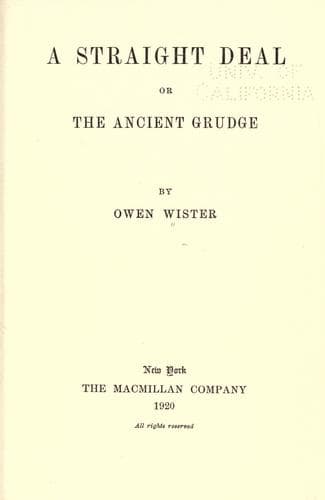
A Straight Deal; Or, The Ancient GrudgeWister, Owen
History
A Straight Deal; Or, The Ancient Grudge
Wister, Owen
Great Britain -- Relations -- United States; United States -- Relations -- Great Britain
“I wish to thank you for your kindly reply.... Your argument is that as
a matter of policy we should conciliate Great Britain. Have we fallen
so low, this great and powerful nation?... Truckling to some other power
because its backing, moral or physical, may some day be of use to us,
even tho’ we know that in so doing we are surrendering our dearest
rights, principles, and dignity!... Oh! my dear Sir, you surely do not
advocate this? I inclose an editorial clipping.... Is it no shock to you
when Winston Churchill shouts to High Heaven that under no circumstances
will Great Britain surrender its supreme control of the seas? This in
reply to President Wilson’s plea for freedom of the seas and curtailment
of armaments.... But as you see, our President and our Mr. Daniels have
already said, ‘Very well, we will outbuild you.’ Never again shall Great
Britain stop our mail ships and search our private mails. Already has
England declared an embargo against our exports in many essential lines
and already are we expressing our dissatisfaction and taking means to
retaliate.”
Of the editorial clipping inclosed with the above, the following is a
part:
“John Bull is our associate in the contest with the Kaiser. There is no
doubt as to his position on that proposition. He went after the Dutch in
great shape. Next to France he led the way and said, ‘Come on, Yanks;
we need your help. We will put you in the first line of trenches where
there will be good gunning. Yes, we will do all of that and at the same
time we will borrow your money, raised by Liberty Loans, and use it for
the purchase of American wheat, pork, and beef.’
“Mr. Bull kept his word. He never flinched or attempted to dodge the
issue. He kept strictly in the middle of the road. His determination
to down the Kaiser with American men, American money, and American food
never abated for a single day during the conflict.”
This editorial has many twins throughout the country. I quote it for its
value as a specimen of that sort of journalistic and political utterance
amongst us, which is as seriously embarrassed by facts as a skunk by its
tail. Had its author said: “The Declaration of Independence was signed
by Christopher Columbus on Washington’s birthday during the siege of
Vicksburg in the presence of Queen Elizabeth and Judas Iscariot,” his
statement would have been equally veracious, and more striking.
Public-domain text, read in full here on John Shaqi.
Reviews
Reviews
No reviews yet
Be the first to share your thoughts on this work.
Join the Discussion
Join the discussion
Sign in to leave a comment or review.
Sign InorCreate an account