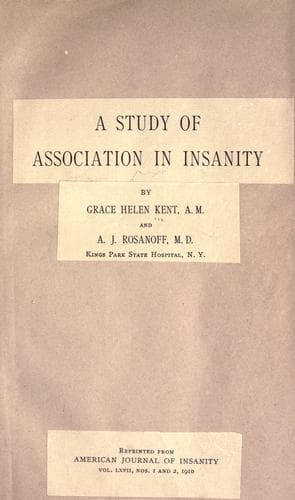
A Study of Association in InsanityKent, Grace Helen
Science
A Study of Association in Insanity
Kent, Grace Helen
Association of ideas; Psychology, Pathological
*Complete Dissociation.*--Here are included reactions which
appear to be entirely unrelated to the corresponding stimulus words;
in the case of such reactions the stimulus words seem to act, as
Aschaffenburg has pointed out, merely as signals for discharge. This
subdivision contains several types of reactions which seem to be
dependent upon the phenomenon of perseveration; it contains also the
rather important type of neologisms.
The phenomenon of *preservation* occurs in cases in which one may
observe an abnormal immobility of attention. To react normally to a
series of stimulus words requires on the part of the subject, in the
first place, a certain alertness in order that he may grasp quickly
and clearly the meaning of each word, and, in the second place, a
prompt shifting of the mind from one reaction to the next. When such
mental mobility is lacking the subject is liable to react not by a
response adjusted to the stimulus word, but either by repeating a
previous stimulus or reaction, or by giving a word associated to the
preceding stimulus or reaction.
The names of the different types of reactions included under the
heading of perseveration are sufficiently descriptive; we shall here
refer only to those which require further definition.
*Association to Preceding Stimulus.*--Here is placed any reaction
that is shown by the frequency tables to be related to the stimulus
preceding the one in question. Seeming or even obvious relationship,
if not established by reference to the frequency tables, is
disregarded. In the tables, however, the combination may not exist in
direct order but only in reverse order, in which case the reaction is
included here. The following examples may serve as illustrations:
_thief--night_
_lion--pocket-book_
_Lion--pocket-book_ is not found in the frequency tables, and is,
therefore, an individual reaction; _thief--pocket-book_, however,
is found there; _pocket-book_ is, therefore, classed in this case
as an association to preceding stimulus.
_table--fork_
_dark--mutton_
_Dark--mutton_ is not found in the frequency tables;
_table--mutton_ is also not found there in the direct order, but
is found in the reverse order, viz.: _mutton--table; mutton_ is,
therefore, classed in this case as an association to preceding
stimulus.
*Association to Preceding Reaction.*--If either the reaction in
question or the preceding reaction happens to be one of the stimulus
words in our list, and a relationship between the two be found to
exist by reference to the frequency tables--whether in direct or in
reverse order--the reaction in question is classed as an association
to preceding reaction. This is illustrated by the following examples:
_eating--table_
_mountain--floor_
_Mountain--floor_ is an individual reaction; _table--floor_
is found in the frequency tables; _floor_ is, therefore, classed
as an association to preceding reaction.
_beautiful--flowers_
_window--red_
Public-domain text, read in full here on John Shaqi.
Reviews
Reviews
No reviews yet
Be the first to share your thoughts on this work.
Join the Discussion
Join the discussion
Sign in to leave a comment or review.
Sign InorCreate an account