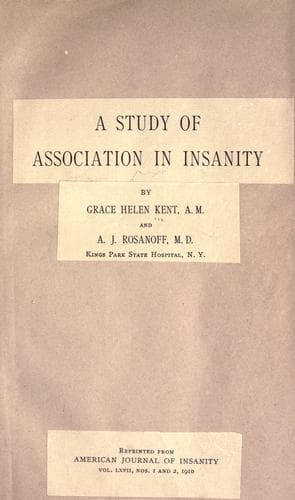
A Study of Association in InsanityKent, Grace Helen
Science
A Study of Association in Insanity
Kent, Grace Helen
Association of ideas; Psychology, Pathological
The stimulus consists of a series of one hundred spoken words, to each
of which the subject is directed to react by the first word which it
makes him think of. In the selection of the stimulus words, sixty-six
of which were taken from the list suggested by Sommer, we have taken
care to avoid such words as are especially liable to call up personal
experiences, and have so arranged the words as to separate any two
which bear an obviously close relation to one another. After much
preliminary experimentation we adopted the following list of words:
01 Table
02 Dark
03 Music
04 Sickness
05 Man
06 Deep
07 Soft
08 Eating
09 Mountain
10 House
11 Black
12 Mutton
13 Comfort
14 Hand
15 Short
16 Fruit
17 Butterfly
18 Smooth
19 Command
20 Chair
21 Sweet
22 Whistle
23 Woman
24 Cold
25 Slow
26 Wish
27 River
28 White
29 Beautiful
30 Window
31 Rough
32 Citizen
33 Foot
34 Spider
35 Needle
36 Red
37 Sleep
38 Anger
39 Carpet
40 Girl
41 High
42 Working
43 Sour
44 Earth
45 Trouble
46 Soldier
47 Cabbage
48 Hard
49 Eagle
50 Stomach
No attempt is made to secure uniformity of external conditions for the
test; the aim has been rather to make it so simple as to render
strictly experimental conditions unnecessary. The test may be made in
any room that is reasonably free from distracting influences; the
subject is seated with his back toward the experimenter, so that he
cannot see the record; he is requested to respond to each stimulus
word by one word, the first word that occurs to him other than the
stimulus word itself, and on no account more than one word. If an
untrained subject reacts by a sentence or phrase, a compound word, or
a different grammatical form of the stimulus word, the reaction is
left unrecorded, and the stimulus word is repeated at the close of the
test.
In this investigation no account is taken of the reaction time. The
reasons for this will be explained later.
The general plan has been first to apply the test to normal persons,
so as to derive empirically a normal standard and to determine, if
possible, the nature and limits of normal variation; and then to apply
it to cases of various forms of insanity and to compare the results
with the normal standard, with a view to determining the nature of
pathological variation.
§ 2. THE NORMAL STANDARD.
In order to establish a standard which should fairly represent at
least all the common types of association and which should show the
extent of such variation as might be due to differences in sex,
temperament, education, and environment, we have applied the test to
over one thousand normal subjects.
Public-domain text, read in full here on John Shaqi.
Reviews
Reviews
No reviews yet
Be the first to share your thoughts on this work.
Join the Discussion
Join the discussion
Sign in to leave a comment or review.
Sign InorCreate an account