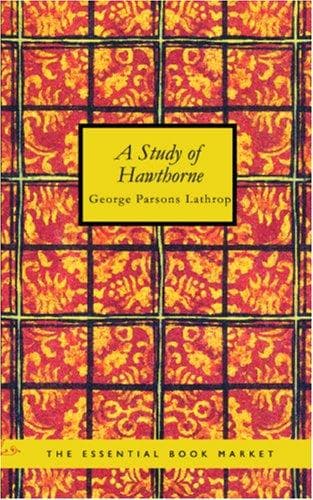
Hawthorne, Nathaniel, 1804-1864; Novelists, American -- 19th century -- Biography
even from themselves"; and this is cited as evidence of "his cold
inquisitiveness, his incredulity, his determination to worm out the
inmost secrets of all associated with him." Such distortion is amazing.
The few poets who search constantly for truth are certainly impelled to
get at the inmost of everything. But what, in Heaven's name, is the
motive? Does any one seriously suppose it to be for the amusement of
making stories out of it? The holding up to one's self the stern and
secret realities of life is no such pleasing pursuit. These men are
driven to it by the divine impulse which has made them seers and
recorders.
As for Hawthorne, he hoped and loved and planned with the same rich
human faith that fills the heart of every manly genius; and if
discouraging truth made him suffer, it was all the more because his
ideals--and at first his trust in their realization--were so generous
and so high. Two of his observations as to Brook Farm, transferred to
the "The Blithedale Romance," show the wisdom on which his withdrawal
was based. The first relates to himself: "No sagacious man will long
retain his sagacity, if he live exclusively among reformers and
progressive people, without periodically returning to the settled system
of things, to correct himself by a new observation from that old
standpoint." He had too much imagination to feel safe in giving free
rein to it, in a special direction of theoretic conduct; he also
remembered that, as the old system of things was full of error, it was
possible that a new one might become so in new ways, unless watched. The
second observation touches the real weakness of the Brook Farm
institution: "It struck me as rather odd, that one of the first
questions raised, after our separation from the greedy, struggling,
self-seeking world, should relate to the possibility of getting the
advantage over the outside barbarians in their own field of labor. But
to own the truth, I very soon became sensible that, _as regarded
society at large, we stood in a position of new hostility rather than
new brotherhood._" And, in fact, the real good which Mr. Ripley's
attempt did, was to implant the co-operative idea in the minds of men
who have gone out into the world to effect its gradual application on a
grander scale. It is by introducing it into one branch of social energy
after another that the regenerative agency of to-day can alone be made
effectual. The leaders of that community have been broad-minded, and
recognize this truth. None of them, however, have ever taken the trouble
to formulate it as Hawthorne did, on perceiving it some years in
advance.
Public-domain text, read in full here on John Shaqi.
Reviews
Reviews
No reviews yet
Be the first to share your thoughts on this work.
Elsewhere in the archive
Join the Discussion
Join the discussion
Sign in to leave a comment or review.
Sign InorCreate an account