A study of some factors influencing fertility and sterility in the bullGilman, Herbert Lester
Science
A study of some factors influencing fertility and sterility in the bull
Gilman, Herbert Lester
Cattle; Infertility in animals; Livestock; Thesis (Ph. D.)
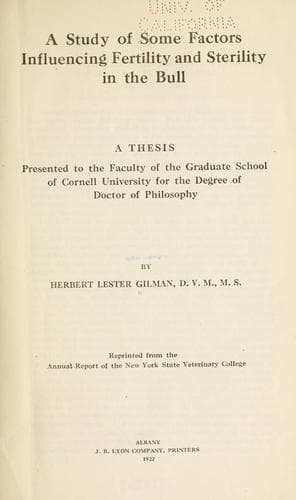
A Study of Some Factors Influencing Fertility and Sterility in the Bull
A THESIS
Presented to the Faculty of the Graduate School of Cornell University
for the Degree of Doctor of Philosophy
BY
HERBERT LESTER GILMAN, D. V. M., M. S.
Reprinted from the
Annual Report of the New York State Veterinary College
ALBANY
J. B. LYON COMPANY, PRINTERS
1922
A STUDY OF SOME FACTORS INFLUENCING FERTILITY AND STERILITY IN THE BULL
HERBERT L. GILMAN
Veterinary Experiment Station, Cornell University
Normal reproduction is the fundamental foundation upon which the entire
cattle industry rests. For this reason, any factor capable of
interfering with it is a detriment to the industry, and a matter of
prime importance to the breeder and the veterinarian. With the relative
increase in number and value of cattle, and the fact that the profession
is depending more and more on this industry for a livelihood, these
problems are assuming greater importance. The part played by the bull
has been emphasized entirely too little, with the result that, as in
human medicine, many fail to appreciate the effects of sterility or
lowered fertility in the male. The part played by the sire in the spread
of genital infections, though discussed frequently, has received little
systematic investigation.
The bull mast be regarded as at least half the herd, not only from the
standpoint of the characters he imprints upon his progeny, but because
of his relation to the reproductive efficiency in the herd. It seems
quite probable that he does disseminate during copulation, infection
associated with the genital organs, with the result that the bull is a
very important factor in a study of the subject. Too frequently, his
ability to copulate in an apparently normal manner, is taken as a
standard of fertility. Gross changes in his genitalia, or the absence of
spermatozoa from the semen are given due consideration, while other more
obscure abnormalities are not looked for nor regarded in their proper
light. Neither fertility nor sterility are always absolute, but the
terms should be used relatively inasmuch as we may have all degrees of
infertility or impotency. All too frequently we forget the many delicate
and intricate mechanisms involved in the reproductive process, with the
result that many phases of the problem are neglected or disregarded. The
genital organs work as a unit, each part of which must function in
perfect accord with the others to the end that full fertility may
result. The physiological factors involved in the formation of the semen
are too little understood, or at best, our knowledge regarding them is
more or less hazy.
Public-domain text, read in full here on John Shaqi.
Reviews
Reviews
No reviews yet
Be the first to share your thoughts on this work.
Join the Discussion
Join the discussion
Sign in to leave a comment or review.
Sign InorCreate an account