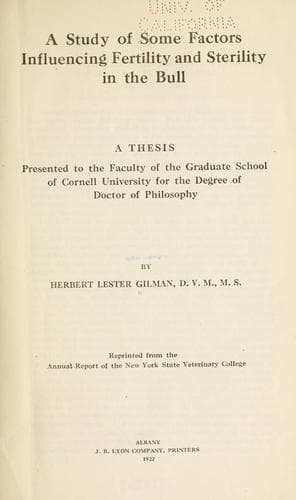
A study of some factors influencing fertility and sterility in the bull — John Shaqi
A study of some factors influencing fertility and sterility in the bullGilman, Herbert Lester
Science
A study of some factors influencing fertility and sterility in the bull
Gilman, Herbert Lester
Cattle; Infertility in animals; Livestock; Thesis (Ph. D.)
A complete bacteriological study was made of the genital tracts of
fourteen normal young veal calves (six to twelve weeks old), four mature
fertile bulls, and sixteen mature bulls, either sterile or impotent to
some degree. Together with these, the tracts of eleven aborted fetuses,
seven calves dying from calf infections (scours or pneumonia), and
sixteen bulls slaughtered at an abattoir were studied bacteriologically.
Occasionally, studies were made of individual seminal vesicles or
testes, when these parts alone were brought or sent in. The history of
the abattoir animals was, of course, quite indefinite or entirely
negative. On the killing floor, many tracts could be studied for
pathological changes, but in the bacteriological work it was difficult
to care for more than two tracts on each visit.
The results of the bacteriological examinations are given in the
appended tables, in which the tracts are divided into six groups. The
results in Group I. consisting of normal veal calves, indicate that the
genital organs of young male calves are, under normal conditions, free
from bacteria. Carpenter (9) obtained like results in examining the
genital tracts of heifer calves. The cultures made from the seminal
vesicles and testes of all these veal calves were, with two exceptions,
negative. Both seminal vesicles of one tract and one of another yielded
cultures of _Staphylococcus albus_.
Adult bulls of known fertility were naturally difficult to obtain, only
the four animals in Group II being available for examination. Two of
these (Nos. 1 and 2) were from the experimental herd kept by the
department, and at all times had a good breeding history. The other two
were good breeders, but were slaughtered because of poor pedigrees. Bull
1, raised in the department herd, had a severe attack of scours when a
few weeks old, while the calfhood history of the other is not known, he
having been purchased after reaching sexual maturity. The cultures from
the genital organs of the former (Bull 1) were entirely negative, except
those from the left epididymis and scrotal sac, which yielded growths of
_Streptococcus viridans_. All the organs of the tract from this animal
were normal, except for the fact that numerous strands of connective
tissue extended from the serous covering of the tail of both epididymes
to the adjacent part of the parietal layer of the tunica. The tract of
the other failed to show any organisms. The only evidence of any
abnormality was the presence of the same connective tissue strands on
the tail of the epididymis, as in the first tract. The other two bulls
gave negative cultures from all parts.
Public-domain text, read in full here on John Shaqi.
Reviews
Reviews
No reviews yet
Be the first to share your thoughts on this work.
Join the Discussion
Join the discussion
Sign in to leave a comment or review.
Sign InorCreate an account