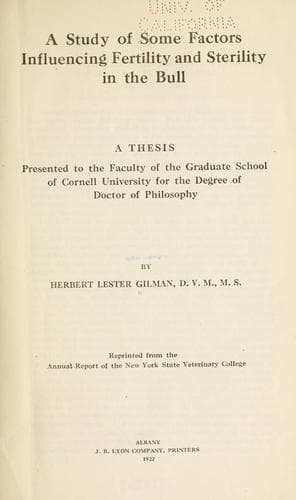
A study of some factors influencing fertility and sterility in the bullGilman, Herbert Lester
Science
A study of some factors influencing fertility and sterility in the bull
Gilman, Herbert Lester
Cattle; Infertility in animals; Livestock; Thesis (Ph. D.)
As the result of a series of experiments, he states:
“... the results fail to justify in the least degree the assumption that
cows are infected with abortion bacilli via their vaginas or uteruses at
the time of copulation, or that the bull, through copulation, is an
agent in the spread of abortion disease.”
The work so far alluded to, has been limited to infection with, and the
transmission of, _Bact. abortum_ and the lesions associated with such
infection. The last mentioned author, however, states: “A search for
other specific causes of abortions among cattle has not been neglected,
and bureau investigators could relate at great length stories similar to
those which investigators have told about microorganisms isolated from
the products of abortions and the uteruses of cows that have aborted.
Bacilli of various kinds, different types of micrococci, and spirilla or
vibrio have been found repeatedly; but when their pathogenicity has been
tested in accordance with widely recognized and accepted and required
bacteriological standards, not one shred of evidence has been obtained
to prove them true etiological factors of bovine abortions. What role
such microorganisms may have as causes of the sequellae of infectious
abortions, and of other, possibly, independent, abnormal processes in
the reproductive organs, is far from clear and merits careful study.”
Hadley (5) mentions the fact that: “Unquestionably the male often
becomes infected with the germs that produce the various secondary
diseases in the female, which are properly classed under the more
inclusive term ‘abortion disease.’” Also, speaking of the rarity with
which the bull acquires abortion infection, he alludes to the fact that
he may act as a “mechanical carrier of various disease germs from an
infected to a healthy cow.” Carpenter (9) working on the female genital
tract, comes to the conclusion that, in all probability, the genital
organs are normally free from bacteria. Barney (13) quoting Huet finds
that bacteria may be present in the seminal vesicles of healthy animals
(horses, cattle, pigs, and laboratory animals). This, he states,
corresponds with the well recognized findings in other parts of the
genito-urinary tract, not only in animals, but in man. He (Huet) has
further found that in animals dying of acute septicemia, the specific
organism (anthrax, pneumococcus) is to be found in the vesicular
secretions. Furthermore it was definitely shown that an infection could
be transmitted to the female during the act of copulation.
Public-domain text, read in full here on John Shaqi.
Reviews
Reviews
No reviews yet
Be the first to share your thoughts on this work.
Join the Discussion
Join the discussion
Sign in to leave a comment or review.
Sign InorCreate an account