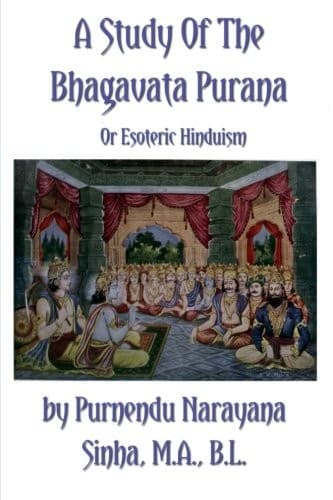
A Study of the Bhâgavata Purâna; or, Esoteric Hinduism
Religion
A Study of the Bhâgavata Purâna; or, Esoteric Hinduism
Puranas. Bhagavatapurana. English
Pradyumna or Kâmadeva presides over Ketumâla in order to please Lakshmî
Samvatsara (one year), the daughters of Samvatsara _viz:_ the nights and
Sons of Samvatsara _viz:_ the days. The days and nights are 36,000 in
number _i.e._ as many as are contained in the full term of a man’s life
(one hundred years). These days and nights are the lords of Ketumâla
Lakshmî with whom the dwellers of Ketumâla adore Kâmadeva.
(The mantra and prayer are then given.)
_Ramyaka._
Matsya (The Fish Incarnation) presides over Ramyaka. Manu is the King.
(Mantra and prayer follow)
_Hiranmaya._
Kûrma (the Tortoise Incarnation) presides over Hiranmaya. Aryaman the
chief of the Pitris dwells there with others.
(Mantra and prayer follow)
_Kuru._
Varsha or the Boar Incarnation presides over Kuru. Bhûr with the
dwellers of Kuru adore him.
(Mantra and prayer follow.)
_Kinpurusha._
In Kinpurusha, Hanumân with the dwellers of the Varsha worship the
Adipurusha Râma, brother of Lakshamana and husband of Sitâ.
(Mantra and prayer follow.)
_Bhârat Varsha._
Nara Nârâyana presides over this Varsha. There are various (castes) and
Âsramas in this Varsha. Nârada of great devotion leads the people of
this Varsha. His object in so doing is to teach to Sâvarni, the coming
Manu, the Sânkhya and Yoga (as related in the Bhagavat Gitâ) together
with the full realisation of Bhagavat (as related in the Pancharatras).
[This mission of Nârada is specially noteworthy.]
( Mantra and prayer follow.)
In this Bhârata Varsha there are many mountains and rivers.
Maloya, Mangalaprastha, Mainâka, Trikuta, Rishava, Kutaka, Kōnva,
Sahya, Rishyamûka, Srisaila, Venkata, Mahendra, Vâridhâra, Vindhya,
Śaktimân, Riksha, Pâripâtra, Drōna, Chitrakûta, Gobardhana, Raivatak,
Kakubha, Nila, Gokâmukha, Indrakila, Kâmagiri and hundreds and thousands
of other mountains are situated in this Varsha.
The following are the principal rivers Chandvavâsa, Tâmvaparni,
Avatōda, Kritamâlā, Vaihâyasi, Kâveri, Venûâ, Payasvini, Sarkarâvartâ,
Krishnavenuâ, Bhimrathi, Godâbari, Nirvindhyâ, Payoshni, Tâpi, Revâ,
Surasâ, Narmadâ, Charmanvati, Andha, Sōna, Mahânadi, Vedasmriti,
Rishikúlyâ, Trisâmâ, Kousiki, Mandâkini, Yamunâ, Sarasvati, Drishadvati,
Gomati, Saraju, Aghavati, Shasthavati, Saptavati, Satadru, Sushōma,
Chandrabhâgâ, Maruduridhâ, Vitastâ, Asikini and Visvâ.
Those that acquire birth in this Varsha have recourse to Svarga,
humanity and Naraka respectively, according as their Karma is White
(Sâtvic), Red (Râjasic) or Black (Tâmasic). The People acquire Moksha in
this Varsha in accordance with their Varna (Caste). (This is because
Karma according to caste prevails in this Varsha, not that Moksha is not
otherwise attainable. _Śridhara_).
Public-domain text, read in full here on John Shaqi.
Reviews
Reviews
No reviews yet
Be the first to share your thoughts on this work.
Elsewhere in the archive
Join the Discussion
Join the discussion
Sign in to leave a comment or review.
Sign InorCreate an account