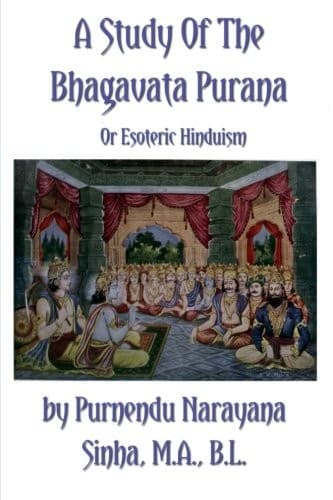
A Study of the Bhâgavata Purâna; or, Esoteric Hinduism
Religion
A Study of the Bhâgavata Purâna; or, Esoteric Hinduism
Puranas. Bhagavatapurana. English
And what is moksha in this Varsha? It is the Companionship of Mahâtmâs
(Mahâpurushas) brought about by the destruction of the bonds of Avidyâ
caused by various births. And that Moksha is in reality unceasing,
unselfish devotion to the All-pervading, Indestructible, Causeless
Paramâtma Vâsudeva.
Even the Devas say: — "How fortunate are these people of Bhârat Varsha!
For Hari is kind to them, even without many performances and they are so
adapted for communion with Hari by devotion. We have attained Svarga by
the performance of Yajna. But we shall have to be born again after the
end of the Kalpa. What good is in this state, which does not bring us in
direct communion with Vishnu? These people of Bhârat Varsha even with
their short lives acquire the state of Hari. If there be any Karma left
to us after the enjoyment of Svarga may we be born as men that we may
worship Hari."
Some say there are eight upadvipas in Jambu Dvipa, formed by the sons of
Sagara when they dug up this earth in search of the sacrificial horse.
They are Svarna Prastha, Chandra Sukla, Âvartana, Râmanaka,
Manda-harina, Panchajanya, Sinhala and Loukâ.
THE DVIPAS.
*SKANDHA V. CHAP. 20.*
_Plaksha Dvipa_
Jambu Dvipa is surrounded by the salt ocean on all sides. That ocean
extends over Laksha Yojanas. That salt ocean is again surrounded on all
sides by Plaksha Dvipa, which extends over 2 laksha of Yojanas.
There is one golden Plaksha tree in that Dvipa as high as the Jambu tree
in Jambu Dvipa and the Dvipa itself takes its name from that tree. There
Fire is seven tongued,
Idhmajihva son of Priyavrata ruled over this Dvipa. He divided the Dvipa
into seven Varshas and named them after his seven sons each of whom
ruled over the Varsha of his name.
Śiva, Vayasa, Subhadrâ, Sânta, Kshema, Amrita and Abhoya are the
Varshas.
Manikûta, Vajrakûta, Indrasena, Jyotishmat, Subarna, Hiranyasthiva and
Meghmâla are the seven chief mountains.
Arunâ, Nrimâna, Angirasi, Sâvitri, Supravâtâ, Ritambharâ and Satyambharâ
are the seven great rivers.
Hansa, Patanga, Urdhâyana and Satyânga are the corresponding castes.
The dwellers of the Dvipa live for one thousand years. They look like
Devas and procreate after Deva fashion. They worship the Sûrya (Sun-god)
of the Vedas.
(The Mantra is given)
In Plaksha, Sâlmali, Kusa, Krouncha and Śaka, the inmates have their
age, Indriyas, strength, power and Budhi by their very birth and not by
Karma.
The Dvipa is surrounded by the Sugar cane juice ocean which extends over
2 laksha of Yojanas.
_Sâlmali Divpa:_ — Twice as large as Plaksha Dvipa. The ocean of wine
surrounding it is equally large.
_Tree:_ — Sâlmali (Bombax Malabaricum) as high as the Plaksha tree said
to be the seat of Garuda.
_King:_ Yajna-vâha son of Priyavrata.
_Seven Varshas and seven sons of Yajnavaha:_ — Surochana, Soumanasya,
Râmanaka, Devvarha, Pâribhadra, Âpyâyana and Abhijhâta.
Public-domain text, read in full here on John Shaqi.
Reviews
Reviews
No reviews yet
Be the first to share your thoughts on this work.
Elsewhere in the archive
Join the Discussion
Join the discussion
Sign in to leave a comment or review.
Sign InorCreate an account