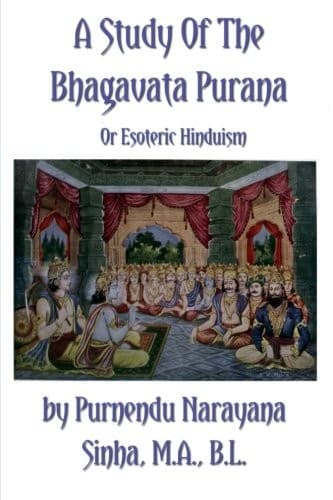
A Study of the Bhâgavata Purâna; or, Esoteric Hinduism
Religion
A Study of the Bhâgavata Purâna; or, Esoteric Hinduism
Puranas. Bhagavatapurana. English
All luminous bodies attached to the wheel of time move round Dhruva
being propelled by Vâyu while Dhruva remains fixed.
The planets and stars remain fixed in their relative positions, under
the union of Prakriti and Purusha by the future made for them by their
Karma.
Some however say that the luminous bodies become fixed in their relative
positions by the Yoga support of Vâsudeva, being held together in the
shape of Sisumâra (the Gangetic porpoise). The Sisumâra has its face
downwards and its body is coiled.
Dhruva is at the end of its tail. Prajâpati, Agni, Indra and Dharma are
in the lower part of the tail. Dhâta and Vidhâta are at the root of the
tail. The seven Rishis are in the middle. On the right side are the
fourteen Stars from Abhijit to Punarvasu. On the left side are the 14
stars from Pushyâ to Uttara Sârhâ. So on, all the stars and planets.
(For details refer to the original).
The Sisumâra is the Universal manifestation of Maha Purusha.
[The following Geo-centric diagram is given, as illustrative of the
positions of the planets.]
[Illustration: Positions of the planets.]
THE PÂTÂLAS
*SKANDHA V. CHAP. 24.*
Ten thousand Yojanas below the Sun is Râhu, son of Sinhika. Though an
Asura, by favour of Bhagavân he became a planet and immortal too like
the Devas.
Ten thousand Yojanas below Râhu is the abode of the Siddhas, Châranas
and Vaidyâdharas.
Below that is the abode of the Yakshas, Râkshasas, Pisâchas, Pretas, and
Bhûtas. This abode extends down to the regions of air and clouds.
One hundred Yojanas below that is the Earth. The details of the Earth’s
surface have been given above.
Underneath the Earth are the seven Patâlas: — Atala, Vitala, Sutala,
Talâtala, Mahâtala, Rasâtala and Pâtâla. They are ten thousand Yojanas
apart from each other.
In these nether Svargas, Daityas, Dânavas and Nâgas dwell. Their
enjoyments, power, joys and luxuries are even greater than those of the
Devas of Svarga. Their houses, gardens and playgrounds are very rich.
They are always joyous. They are attached to their wives, sons, friends
and attendants. By the grace of Îsvara, their desires are always
gratified.
Mâyâ, the Dânava Magician, has built wonderful houses, gardens &c. in
these regions with precious stones.
There are no divisions of time, as the Sun’s rays do not enter those
regions and no disturbances from such divisions. All darkness is removed
by the light of the precious stones on the head of the serpent king.
The people of Pâtâla use divine herbs and medicines, and consequently
they have no infirmities, diseases, old age, languor and offensive
secretions.
They have no death except by the Chakra of Bhagavân (_i.e._ final
extinction).
_Atala:_ — Bala, the son of Maya resides in Atala (Maya is a masculine
form of Mâyâ the root Prakriti). He created here 96 forms of Mâyâ. The
Mâyâvins (those who practice Magic) still have recourse to those forms.
When he yawns, three classes of women spring into existence viz:
Public-domain text, read in full here on John Shaqi.
Reviews
Reviews
No reviews yet
Be the first to share your thoughts on this work.
Elsewhere in the archive
Join the Discussion
Join the discussion
Sign in to leave a comment or review.
Sign InorCreate an account