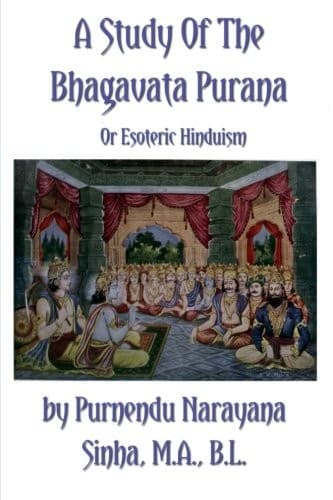
A Study of the Bhâgavata Purâna; or, Esoteric Hinduism
Religion
A Study of the Bhâgavata Purâna; or, Esoteric Hinduism
Puranas. Bhagavatapurana. English
1. Svairini (self willed loose women),
2. Kâmini (passionate women) and
3. Punschali (unchaste women).
If any one enters Atala these women completely allure him by their
Hâtaka (golden) charm, and when the man is completely overcome by their
allurements, he says "I am Îsvara", "I am Siddha."
[The women are only forms of Mâyâ because Mâyâ is personified as an
alluring woman. A man in Atala is completely under the domination of
Mâyâ and becomes estranged from spirit. So Mâyâ is all in all to him and
he knows no other.]
_Vitala_: — Below Atala is Vitala. There Bhava (Śiva) the king of Gold
reigns in company with his consort Bhavâni, attended by Bhûtas. He
remains there for the benefit of the Prajâpati creation. The fluid of
intercourse with Bhavâni gives rise to a river called Hâtaki (Golden).
Agni kindled by Vâyu drinks up that river and gives out the gold called
Hâtaka which is used in ornaments by the Asuras who dwell there.
(We have known Śiva as the Astral Lord. We find him here engaged in the
work of creation. The text speaks of a mysterious connection between him
and the gold called Hâtaka. The occult varieties of gold such as
Jâmvanada and Hâtaka form a fit subject of study. Hâtaka refers to the
Prajâpati creation. There is duality in Vitala, as distinguished from
the singleness of Mâyâ in Atala).
_Sutala_: — Below Vitala is Sutala. There the renowned Bali son of
Virochana still dwells. Vâmana, the Dwarf Incarnation of Vishnu, took
away the Trilokî from him and replaced him here. His enjoyments even
here are greater than those of Indra. He performs Sva-dharma and
worships Vishnu. His sins are all removed.
(A full account of Bali will be given below.)
_Talâtala_: — Below Sutala is Talâtala. Mâyâ, the Dânava king, rules
there. His "Three Puras" (abodes) were destroyed by Śiva who is hence
called Tripurari. But Śiva favoured him again and placed him in
Talâtala. He is the preceptor of all Mâyâvins. He is preserved by Śiva
and he has no fear from Sudarsana (the chakra weapon of Vishnu, which
symbolises Time.)
(Bali and Mâyâ, Trilokî and Tripura, the seizure of one and the
destruction of the other, the restoration of Bali to Sutala and of Mâyâ
to Talâtala, the favour shown to them in those regions, the
correspondences of Sutala and Talâtala are worth careful consideration.
In the case of one, Vishnu or the Preservative aspect of the Second
Purusha is the actor, and in the other, Śiva, the Destructive aspect.)
_Mahâtala_: — Below Talâtala is Mahâtala. Many headed serpents, the
progeny of Kadru, dwell there. The chief amongst them are Kuhaka,
Takshaka, Kâliya, Sushena, and others. They are always afraid of Garuda,
the Vehicle of Vishnu, and they are therefore seldom seen to indulge in
pleasure-trips outside.
Public-domain text, read in full here on John Shaqi.
Reviews
Reviews
No reviews yet
Be the first to share your thoughts on this work.
Elsewhere in the archive
Join the Discussion
Join the discussion
Sign in to leave a comment or review.
Sign InorCreate an account