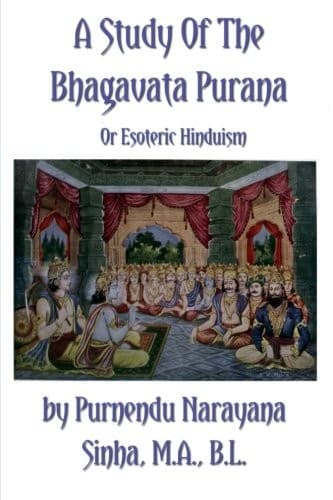
A Study of the Bhâgavata Purâna; or, Esoteric Hinduism
Religion
A Study of the Bhâgavata Purâna; or, Esoteric Hinduism
Puranas. Bhagavatapurana. English
Vyâsa drew upon his inspiration and wrote the Bhâgavata. He taught this
Purâna to his son, the wonderful Suka. Suka did not marry, as Rishis in
his time did. He left his home and roamed about the world at large,
stark naked. The separation was painful to Vyâsa and he went out in
search of his son. While he passed near a tank, the Apsarasas, who were
freely indulging in play, hastily drew up their clothes, feeling
ashamed. "Strange!" exclaimed Vyâsa, "I am old and covered. But when my
young son, wholly uncovered, went this way, you remained unmoved." And
the Deva-ladies replied, "Thy son knows not man and woman, but thou
knowest." This exalted Suka was the worthy propounder of the Bhâgavata
Purâna.
Râjâ Parikshit, son of Abhimanyu and grandson of Arjuna, the successor
of Râjâ Yudisthira on the throne of Hastinâpura, forgot himself in a fit
of anger and placed a dead serpent round the neck of a Rishi. For this
he was cursed by the Rishi’s son to meet with untimely death at the end
of a week. The Râjâ became penitent and deemed the curse an act of God.
He prepared himself for death and took up his abode on the sacred banks
of the Ganges in company with all the Rishis. The Râjâ asked what a man
on the point of death should do. The Rishis present could not give any
satisfactory answer. At this time Suka appeared, followed by a host of
boys, who took him to be a mad man. Suka was then only sixteen with long
flowing hairs and well-built body, blooming with nature’s beauty. All
rose up as they saw the very young Rishi, and gave him the first seat.
He related the Bhâgavata Purâna to Parikshit in seven days.
The Râjâ repeated his question to Suka — "What is a dying man,
specially one who desires to attain Moksha, to do? What are the duties
of men and what are they not to do?"
Suka replied: — "A man on the approach of death is to give up all fear
of death and is to cut off all likes and dislikes by dispassion. He is
to leave his house, bathe in pure water and duly make his âsana in some
solitary place. He is then to meditate on the three lettered Pranava
with mind concentrated by Dhârâna and Dhyâna till he attains _samâdhi_.
If, however, his mind gets distracted by Rajas and Tamas, he is again
and again to practise Dhârâna."
"What Dhârâna is it that speedily brings on concentration and purity of
mind?" was the next question.
Suka replied: — "Dhârâna of the Sthûla aspect of Bhagavâna, by a fully
controlled mind." He then went on dilating on the Sthûla or Universe
aspect, called Virât Purusha or Mahâpurusha. The present, the past, the
future is manifest in that aspect. The Virâta Purusha is the soul of an
Egg-like body with a seven-fold cover of earth, water, fire, air, âkasa,
Ahankâra, and Mahat, respectively.
Pâtâla is His feet, Rasâtala His heels, Mahâtala His ankles, Talâtala
His legs, Sutala His knees, Vitala the lower portion of His thighs, and
Atala the upper portion.
Public-domain text, read in full here on John Shaqi.
Reviews
Reviews
No reviews yet
Be the first to share your thoughts on this work.
Join the Discussion
Join the discussion
Sign in to leave a comment or review.
Sign InorCreate an account