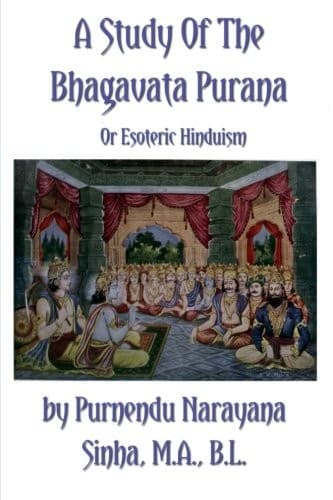
A Study of the Bhâgavata Purâna; or, Esoteric Hinduism
Religion
A Study of the Bhâgavata Purâna; or, Esoteric Hinduism
Puranas. Bhagavatapurana. English
Hiranyâksha is Tâmasic. He represents the original inertia of matter,
its primary resistance to the onward process of evolution. There was
existence after Pralâyic sleep But it was homogeneous existence, with
little or no phenomenal change. Varâha got over this homogeneal tenacity
by the killing of Hiranyâksha, and he set going the process of planetary
and individual life.
Hiranyakasipu came next. He was the favoured son of Brahmâ. He helped
the evolution of individual life. Minerals became vegetables. Vegetables
became animals, and animals became men. The intellectual power of men
rapidly increased, and there was material and moral progress. The limit
of moral progress was reached by Prahlâda. But the ideal of Prahlâda was
based upon the conception of differences and of individualities. It is
for this reason that Varna and Ashrama Dharma, or the separate duties of
life for separate classes of men, is dealt with in the discourses with
Prahlâda.
But though Prahlâda was a son of Hiranyakasipu, he was an exception to
the general run of material evolution which was fostered by
Hiranyakasipu. Hiranyakasipu hated the development of Sâtvic virtues, he
hated Hari, the embodiment of Satva. Nrisinha killed the great Daitya,
and Satva made its appearance in men.
Hiranya means gold.
Hiranyâksha is gold-eyed.
Hiranyakasipu is gold bedded.
II. _Râvana and Kumbhakarna._
Hiranyakasipu represented the gradual development of material and
intellectual evolution, till the highest point was reached.
Then there was a period of intellectual abuse. The Intellect of man
tried to get a supremacy over the established order of things: Râvana
sought to make Nature subservient to his own purposes. The universe
existed for man, and not man for nature. This was the perverse idea that
guided the people of the Atlantean Continent. The intellectual giants,
maddened by this material grandeur, did not look for any world beyond
the one they lived in. They cared not for Svarga, nor for the sacrifices
that led to Svarga. The flow of evolution, the breath of Íshvara seemed
to stand still for a time as it were. The human will tried to override
the divine will. There was chaos and disorder, which tended to cause
dissolution in the universe. Hence Râvana was a Râkshasa. The Tâmasic
Kumbhakarna with his six-monthly sleep was the back ground of Râvana.
The spiritual forces that were called forth to put an end to this state
of things were equal to the occasion. The great Atlantean Continent was
washed away by the sea. The sacred Gangâ came rushing forward from the
heights of the Himalayas, and eventually Râma appeared to give a
finishing stroke to the evolutionary work of the time.
Vishvâmitra and others had paved the way for the great work undertaken
by Râma. They propounded the Karma Kânda of the Vedas.
Public-domain text, read in full here on John Shaqi.
Reviews
Reviews
No reviews yet
Be the first to share your thoughts on this work.
Elsewhere in the archive
Join the Discussion
Join the discussion
Sign in to leave a comment or review.
Sign InorCreate an account