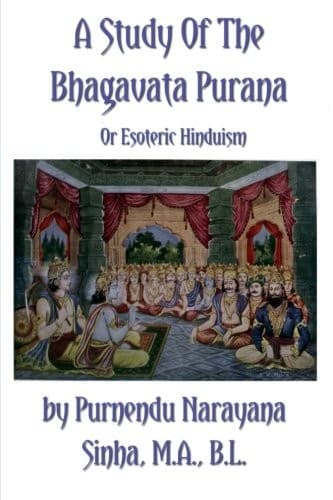
A Study of the Bhâgavata Purâna; or, Esoteric Hinduism
Religion
A Study of the Bhâgavata Purâna; or, Esoteric Hinduism
Puranas. Bhagavatapurana. English
Men who knew nothing but the joys and sorrows of this short span of
earthly life, and whose ideas and aspirations were all confined to that
life, made a great advance when they were taught of an existence after
death. When they further knew that life in Svarga was infinitely happier
and far more lasting than what they called life on this earth, they made
the beginning of a really spiritual life. The Vedic Devas are permanent
dwellers in Svarga, and the Vedic Sacrifices establish communion with
them by means of Apurva, a spiritual force generated by the performance
of sacrifices, and life in Svarga becomes prolonged for a very very long
period. People took time to understand this truth, but in time they
accepted the performance of Vedic Sacrifices as the only religion for
man.
There was however a re-action. The intellectual giants, called
Râkshasas, looked down upon Vedic Sacrifices, and they did not care for
any life after death. They were the worst enemies of the Vedic Rishis.
Vishvâmitra took the help of Râma in protecting the Rishis in the
peaceful performance of Yajnas.
But people had grown old in their ideas about Vedic sacrifices. The
first seceders were some Kshatriyas. They did not understand why Vedic
Sacrifices should be the monopoly of Brâhmanas, and they aspired to the
position acquired by them. The foremost of these Kshatriyas were the
Haihayas and Tâlajanghas. But they were defeated by Parashurama, who
re-established the supremacy of the Brâhmanas.
But a silent revolution was going on, in which the Kshatriyas and
Brâhmanas equally took part. King Janaka and Rishi Yajnavalkya gave the
finishing stroke to the Upanishad movement, and side by side with Karma
Kânda grew up the Jnâna Kânda of the Vedas. Râma brought the two
divisions of the Vedas into closer union, as he was himself the resting
place of both. And as Vishnu himself, He became the object of Upâsanâ.
The three Paths appeared, that of Karma, Bhakti and Jnâna. Vedic
Sacrifices held their own, and a school grew up which accepted these as
the highest Karma which man could perform. Another school, following the
very old teachings of Kapila, dissected the transformable parts in man
and discriminated the same from the non-transformable. A sister school
followed up the teaching with practices in conformity to these, and
taught how to concentrate the mind on the discriminated Atmâ. Another
school confined itself to the properties of matter and mind, soul and
oversoul, and remained wonder-struck at the superior properties that
divided Jiva from Íshvara. Schools of independent thought grew up. Each
school had its followers. There were differences and dissensions. There
was disunion, self-sufficiency, pride, envy, jealousy and other evil
traits of human character that thinks too much of itself. Every one
followed his own faith and hated the follower of other faiths. This was
the cycle of Shishupâla and Dantavakta.
Public-domain text, read in full here on John Shaqi.
Reviews
Reviews
No reviews yet
Be the first to share your thoughts on this work.
Elsewhere in the archive
Join the Discussion
Join the discussion
Sign in to leave a comment or review.
Sign InorCreate an account