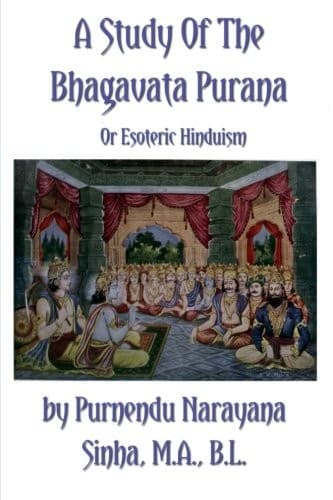
A Study of the Bhâgavata Purâna; or, Esoteric Hinduism
Religion
A Study of the Bhâgavata Purâna; or, Esoteric Hinduism
Puranas. Bhagavatapurana. English
As long as the mind is not fixed by Dhârâna, meditate on this form of
Íshvara, with the help of thy imagination. Concentrate your mind on one
limb after another, beginning with the feet of Vishnu and ending with
His smiling face. Try to grasp every limb in thought and then proceed to
the next-higher. But as long as Bhakti or Devotion is not developed, do
not fail to contemplate also on the Universe aspect of Purusha.
THE DEATH OF THE YOGI AND AFTER.
*SKANDHA II., CHAP. 2.*
When all desires are controlled by meditation, and the Yogi is lost in
the contemplation of Vishnu, he sits in proper posture, pressing his
feet against the anus and perseveringly draws the vital air upwards to
the six centres. He draws the air in the navel centre (Manipur) to the
cardiac plexus, thence to the plexus beneath the throat (Visúddha),
thence gradually by intuition to the root of the palate. (Śridhara Svâmi
calls this last the higher part of Visúddha chakra, and remarks that the
vital air is not displaced from that position. This may be called the
pharyngeal plexus.) Thence he takes the vital air to Ajna chakra, which
is situated between the two eye-brows. Then he controls the seven holes
(the ears, the eyes, the nostrils and the mouth). He then looks steadily
for half a Muhurta, and if he has not a trace of desire left in him
gives up the body and the Indriyas, passes out through the
Brahmâ-randhra and attains the state of Vishnu.
[It will be noticed above that six plexuses are mentioned other than the
Sacral and the prostatic.
In the death of the desireless Yogi, there is no record of thereafter,
for nothing is known beyond our cosmos.]
"But, O king," said Suka, "if the Yogi seeks for the highest cosmic
state or for the roamings of aerial Siddhas over the whole of cosmos, in
full control of the eight Siddhis, he will then take his Manas and
Indriyas with him. It is said that these Masters of Yoga can move both
inside and outside Trilokî, for their Linga Sarira consists of the atoms
of air. The state attained by those that acquire Samâdhi by Upâsana,
Tapas and Yoga cannot be reached by Vedic Karma. In space when the Yogi
moves towards the Brahmâ Loka or Satya Loka, he first goes by means of
his Sushumnâ Nâdi to Vaisvânara or the fire-god for the Sushumnâ by its
light extends beyond the body. His impurities being all washed away, he
goes upwards to the Sisumâra Chakra of Hari (_i.e._, up to the highest
point of Trilokî, as will be explained afterwards). Then crossing that
Chakra of Vishnu, which is the navel of the Universe, he reaches the
Mahar Loka with his pure Linga Sarira. There the dwellers of Svarga
cannot go. Mahar Loka is the abode of Brahmâvids, where Bhrigu and other
adepts who live for a whole Kalpa dwell.
Public-domain text, read in full here on John Shaqi.
Reviews
Reviews
No reviews yet
Be the first to share your thoughts on this work.
Join the Discussion
Join the discussion
Sign in to leave a comment or review.
Sign InorCreate an account