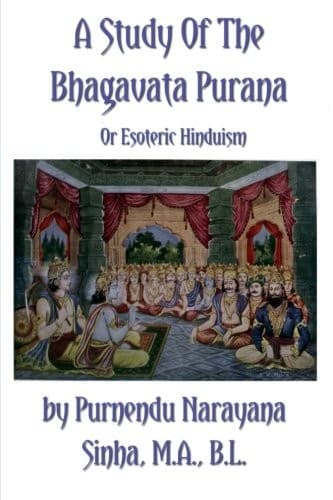
A Study of the Bhâgavata Purâna; or, Esoteric Hinduism
Religion
A Study of the Bhâgavata Purâna; or, Esoteric Hinduism
Puranas. Bhagavatapurana. English
"O guide of the Universe! what is thy difficulty in saving all men? For
Thou art the cause of the creation, preservation and destruction of the
Universe. Thou hast much kindness for the ignorant. Thou art the friend
of the afflicted. What then by saving us only who serve thy favorite men
the Mahâtmâs (for, those who serve the Mahâtmâs are already saved).
"O Thou Supreme, I am not the least anxious for myself about the
Vaitarani (Trilokî existence), however difficult to cross it may be, for
my mind is plunged in the nectar ocean of singing thy glory. But I mourn
for the ignorant, those that care only for the gratification of the
senses and for the means of such gratification while they remain
estranged from Thee.
"Generally, O Deva! the Munis are desirous of their own Moksha, they
hold their tongue, and roam in solitude without caring for the good of
others. But I do not like to be liberated alone, leaving behind me the
afflicted round me; I find no other shelter for these misguided people,
besides Thee.
"They are not happy, O Lord, in the enjoyment of the objects of the
senses. For like itching, it is not a pleasure by itself but seems to be
so, as long as Thou art not known.
"It is said that holding the tongue (_mouna_) vowed observance (Vrata),
sacred knowledge (Sruta), austerity (Tapas), reading (Adhyayana), the
observance of rules pertaining to one’s caste (Sva Dharma), exposition
of Shastras (Vyâkhyâ), living in solitude (Rahas), recital of Mantra
(Japa), and Samâdhi also lead to Moksha. But generally it is seen that
these are only means of livelihood for those that have no control over
their senses. And for proud people they are sometimes the means of
livelihood and sometimes not. But pride in itself is not a good thing.
"Thou art not separate from the Universe. Both cause and effect are thy
forms. It is not by avoiding the ways of Universe but by seeing Thee
everywhere by means of Bhakti, that the right course is followed. It is
by striking one stone against another that fire comes out, and not
otherwise."
[Let the words of the Asura boy resound from one end of India to the
other. Let the sublime words of compassion and universal love be written
in characters of gold, and let them be engraven in the hearts of all
Indians]. Prahlâda was made the king of the Asuras.
VARNA AND ASHRAMA.
*SKANDHA VII, CHAP. 11 TO 15.*
Nârada related the story of Prahlâda to King Yudhisthira at the Rajasûya
sacrifice. That story revealed the highest devotion that was possible
for a Jiva to attain with the idea of separate existence. But separation
also gives rise to the idea of difference. And as differences become
established in society, duties and relations become manifold.
Yudhisthira therefore appropriately asked Nârada about the Varnâsrama
duties.
Public-domain text, read in full here on John Shaqi.
Reviews
Reviews
No reviews yet
Be the first to share your thoughts on this work.
Elsewhere in the archive
Join the Discussion
Join the discussion
Sign in to leave a comment or review.
Sign InorCreate an account