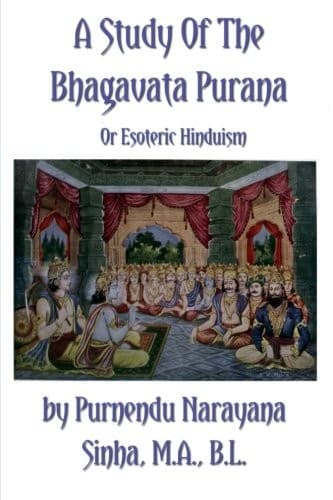
A Study of the Bhâgavata Purâna; or, Esoteric Hinduism
Religion
A Study of the Bhâgavata Purâna; or, Esoteric Hinduism
Puranas. Bhagavatapurana. English
The general rules to be observed by all castes are first given, ethical,
spiritual and devotional. The specific duties and indications of each
caste are then given, much the same as given in Manu Sanhitâ, as also
the duties of women. The following significant passage occurs at the
end: —
"The indications of each caste are given above (e.g. restraint of the
senses, contentment, &c., for Brâhmanas; courage, strength, &c., for
Kshatriyas; reverence, energy, &c., for Vaishyas; and humanity, service
&c., for Shudras). If however the indications of one caste are found in
a man belonging to another caste, he is to be specified by the caste of
his indications and not the caste of his birth." VII — 35.
The commentary of Śridhara is explicit on this passage. This shews the
liberality of the Bhâgavata Purâna. According to this Purâna, the
divisions of caste at the present day, (for one must not forget that the
Vaishnava movement belongs comparatively to a later period), are not to
be determined by birth, but they are indicated by the virtues of each
particular individual.
The duties of each Âsrama are next enumerated in detail. The enumeration
follows the Smritis, with a word for Bhakti Yoga where necessary. Some
very useful hints are given for a Grihasthâ, for which please refer to
the original.
The paths called Pitriyâna and Devayâna are next described. Hints on
Yoga and the recital of Pranava are also given.
SKANDHA VIII.
YAJNA.
*SKANDHA VIII. CHAP. 1.*
An account has been given above of the progeny of Devahûti and Prasuti.
Yajna is the son of Akuti. In the First Manvantara, when Asuras and
Râkshasas were going to devour Manu, Yajna killed the former, with the
help of his sons, the Yâma Devas. He ruled over Svarga as the Indra of
that Manvantara.
[This brings us to the end of the 1st Manvantara. The narration at
several places took us to later Manvantaras, and the account of the
Asuras especially took us to Vaivasvata Manvantara. The account of the
first Manvantara is illustrative of the succeeding Manvantaras. Details
have therefore been given at times which might not properly pertain to
the 1st Manvantara, but which fit in with other Manvantaras at those
stages of the narration. Necessarily the account of the succeeding
Manvantaras is very meagre.]
*END OF THE FIRST MANVANTARA.*
THE SECOND MANVANTARA.
*SKANDHA VIII. CHAP. 1.*
Svârōchisha is the 2nd Manu. (Svârōchisha = Self refulgent). He is the
son of Agni; Dyumat, Sushena, Rochishmat and others are the sons of this
Manu. (Dyumat and Rochishmat also mean bright, refulgent). Rochana was
the Indra (Rochana = bright illuminating). Tushita and others were the
Devas. Urjastambha and others were the seven Rishis well versed in
Brahmâ Vidyâ.
There was one Rishi named Veda Siras. His wife was Tushitâ. He had by
her _Vibhu_, the Avatâra of this Manvantara. Vibhu took the vow of
Brahmâcharya and never married. 80,000 Rishis learned his Vrata.
Public-domain text, read in full here on John Shaqi.
Reviews
Reviews
No reviews yet
Be the first to share your thoughts on this work.
Elsewhere in the archive
Join the Discussion
Join the discussion
Sign in to leave a comment or review.
Sign InorCreate an account