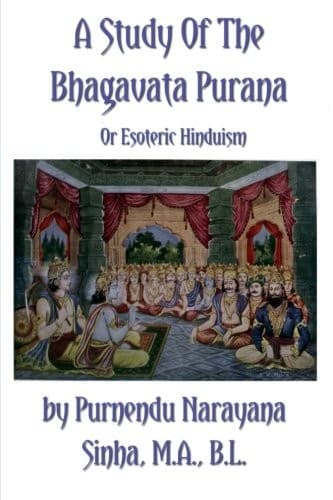
A Study of the Bhâgavata Purâna; or, Esoteric Hinduism
Religion
A Study of the Bhâgavata Purâna; or, Esoteric Hinduism
Puranas. Bhagavatapurana. English
The next line, that of Narishyanta, shews further materiality. Midhvat
is that which wets (the root _mih_ means to pass water). _Viti_ is
production, enjoyments. Vitihotra is the name of a sacrificial fire.
_Agnivesya_ is an incarnation of Agni or the Fire-God, but he is
nick-named Kânina or son of an unmarried woman and also _Jâtukarna_ (the
name of a Vedic Rishi). There seems to have been sexual procreation in
this line. The incarnation of Agni further indicates that the present
human form was complete, for Agni is the form-giving energy in Nature.
In the next line of _Dishta_ we have _Vatsapriti_ or affection for
children, _Pransu_ or tall, _Pramati_ or full-grown intellect,
_Khanitra_ or digger, _Châkshusha_ or the eyed, and _Khaninetra_ or the
hollow-eyed. This line represents the race of the earliest diggers, very
tall, with the hollow eye predominant in them as a characteristic
feature; this race was very powerful and capable of direct communion
with the Devas, and the gods acted as waiters in the Yajna of Marutta.
The line of Saryâti refers to Ânarta and a town named Kusasthalî, built
in the midst of the Sea. Evidently the continent on which the race
flourished is now under water. Ânarta is supposed to be Sourâshtra
(modern Surat.) But the site of Kusasthalî cannot be ascertained. There
were remnants of this race till the time of Krishna, for Balarâm married
Revati, the daughter of Kakudmin (hump-backed). The line of Nabhaga is a
short one and it merged itself into that of Angiras who was the father
of Brihaspati or Jupiter. Ambarisha is the prominent figure of this
period.
Then we come to the line of _Ikshvâku_. This is the best known line of
the Solar races. It flourished during the last Tretayuga. _Ikshvâku_ is
called the eldest son of Manu. Perhaps this has reference to the
appearance of the Race in the previous Manvantaras.
The eldest son of Ikshvâku is Vikukshi (_Kukshi_ is womb.) He is also
called Sasada or the Rabbit-eater. The Moon is called Rabbit-marked.
_Puranjaya_ is the son of Vikukshi. He is called Indra-Vâha or
Indra-Vehicled. Several of the kings of this dynasty befriended the
Devas of Svar Loka.
Further down we find King _Purukutsa_ forming an alliance with the
elemental serpents, and holding communion with the dwellers of Rasâtala.
The river Narvadâ is mentioned in connection with Rasâtala.
Public-domain text, read in full here on John Shaqi.
Reviews
Reviews
No reviews yet
Be the first to share your thoughts on this work.
Elsewhere in the archive
Join the Discussion
Join the discussion
Sign in to leave a comment or review.
Sign InorCreate an account