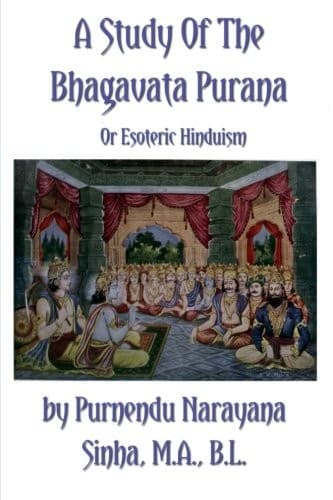
A Study of the Bhâgavata Purâna; or, Esoteric Hinduism
Religion
A Study of the Bhâgavata Purâna; or, Esoteric Hinduism
Puranas. Bhagavatapurana. English
_Mândhâtâ_ is a traditional name that has been preserved upto this time
in common parlance in the saying "As old as king Mândhâtâ." The line of
Mândhâtâ was divided into three different branches. _Muchukunda_
represented a branch of Yogins. The long, unbroken sleep of Muchukunda
is traditional and he is credited also with Yogic powers. Another branch
that of Ambarisha, Youvanâsva and Hârita represented a spiritual
sub-race. But we have to follow the history of the Atlanteans through
Purukutsa. The connection with Rasâtala, or the plane of Material
ascendancy, affected the destiny of this line. In Trisanku, the
aspiration ran very high. He became a Deva, but had his head turned
downwards, _i.e._ turned towards materiality. With the powers of a Deva,
but with the aspirations of an Asura, the ground was prepared for the
downfall of this line. For a time, however, the Race flourished in all
its materiality. The alliance between Devas and men became cemented by
the performance of Vedic sacrifices. This was the first spiritual
advance of the human race, through the temptations of Svarga life.
The time of Haris Chandra is the Vedic era, when the earliest Riks of
what we know as Rigveda were composed. Visvâmitra and his disciples were
the Vedic Rishis of this age. The Vedas tried to curb the riotous course
of materiality by prescribing a number of restrictions on the enjoyment
of material desires. Elaborate rules were laid down as to how the
desires might be best gratified for a prolonged period in Svargaloka, by
the performance of sacrifices or Yajna. The whole of the life of the
regenerate classes was regulated by rigid laws and a glowing picture was
given of life in Svarga after death. The sacred injunctions were not,
however, potent enough to check the Kâmic tendencies of the race and the
cyclic law which now required the spiritual evolution of humanity was
continually disregarded by the race. This was poison (_gara_) to the
system of humanity and king Sagar imbibed this poison. Hence he was
called the Poisoned. He had two wives. The sons of one wife were 60
thousand in number. They offended Kapila, an Incarnation of Vishnu, and
thus were all consumed. They reached the limit of material degradation,
where final extinction awaited the race. The number 60,000 is
suggestive.
Public-domain text, read in full here on John Shaqi.
Reviews
Reviews
No reviews yet
Be the first to share your thoughts on this work.
Elsewhere in the archive
Join the Discussion
Join the discussion
Sign in to leave a comment or review.
Sign InorCreate an account