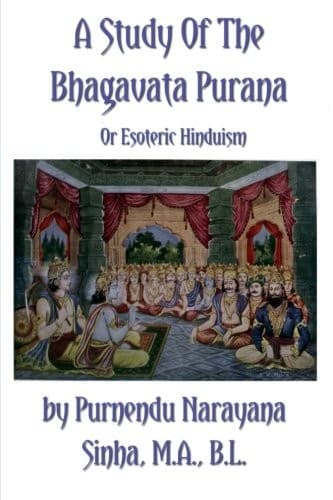
A Study of the Bhâgavata Purâna; or, Esoteric Hinduism
Religion
A Study of the Bhâgavata Purâna; or, Esoteric Hinduism
Puranas. Bhagavatapurana. English
Therefore by the words: "He consumes him," it is meant, that the perfect
performer obtains the highest state of Prajâpati, he, who is less
perfect, does not obtain it, and by no means, that the less perfect
performer is actually consumed by the perfect.
Here the word Prajâpati refers to the Second Purusha.
The state of the Second Purusha is the highest achievement of Jiva. It
is the meeting ground of Jiva and the Supreme Purusha. The Second
Purusha may be different for each Kalpa, it may be for each Brahmânda.
He is the Íshvara, the Lord of our Universe. He holds the whole creation
unto His bosom, and is the sustaining force of all. In the three aspects
of Brahmâ, Vishnu and Śiva, he guides the creation, the preservation and
the dissolution of the Universe. Those that could not attain His state,
though they strove for it equally as eminent as the Second Purusha, that
are to become the Second Purusha in perhaps another Kalpa or Brahmânda,
are the Lilâ Avatâras. They remain merged in the Second Purusha or
Íshvara and they manifest themselves in the Universe, only when a
necessity arises for their manifestation. The Bhâgavata contends that of
all Lilâ Avatâras, only Krishna is Purusha Himself the others being only
partial manifestations of Purusha.
"These are the parts and aspects of Purusha. Krishna is Bhagavân
Himself." — I-3-28.
Tamas is dark, opaque and heavy on the physical plane, indolent and
ignorant on the mental plane, non-perceptive on the spiritual plane.
Rajas is translucent, and constantly moving on the physical plane;
distracted constantly, acquiring likes and dislikes, and exercising
intellection on the mental plane; and partially perceptive on the
spiritual plane.
Satva is light and transparent on the physical plane, cheerful and
buoyant on the mental plane, and fully perceptive on the spiritual
plane. True perception and real knowledge follow from Satva. By partial
understanding and semblance of knowledge, the results of Rajas, people
become distracted and led astray.
Tamas keeps down all beings and enchains them to materiality in the
course of evolution, and there is a point in the downfall of beings as
well as of globes, beyond which there is a complete break-down. Satva
counter-acts Tamas and the preservation and improvement of the Universe,
rather of Trilokî, there fore mean the infusion of Satva. Vishnu
represents Satva and so Vishnu is the Preservative aspect of Virâta
Purusha. When Rajas and Tamas predominate in Trilokî, when the lowest
plane Bhûr becomes heavy with Tamas, the Lilâ Avatâras appear and infuse
Satva into the Lokas.
*SKANDHA I., CHAP. 2-34.*
This Preserver of Lokas preserves the Lokas by means of Satva, by
incarnating in Deva, Animal, Human and other kingdoms as Lilâ Avatâras.
Public-domain text, read in full here on John Shaqi.
Reviews
Reviews
No reviews yet
Be the first to share your thoughts on this work.
Join the Discussion
Join the discussion
Sign in to leave a comment or review.
Sign InorCreate an account