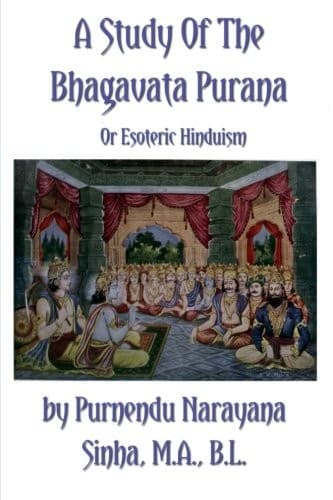
A Study of the Bhâgavata Purâna; or, Esoteric Hinduism
Religion
A Study of the Bhâgavata Purâna; or, Esoteric Hinduism
Puranas. Bhagavatapurana. English
The world admired Râma. No man could reach such eminence. He must be
something more than a man. In time men accepted him as an Avatâra. At
any rate, he was an example to others in every respect. The ethical
standard he laid down in his own life was unimpeachable. The world had
never seen such sacrifices in the performance of the duties of life. A
model king, a model son, a model husband, a model brother, a model
warrior, a model friend, the model of models, Râma left an indelible
mark as a religious and moral teacher, on the age in which he lived, and
on all succeeding ages.
The example was not lost on the world. The many-sided picture, that Râma
presented, produced a spirit of enquiry, which has never been rivalled
in this Kalpa. Men thought on different lines. They studied the
Upanishads, which had been favoured by Râma. They could not forget also
that Râma taught salvation for the performers of Vedic sacrifices. Then
there was the teaching of his own life. The light was manifold.
Independent schools of thought grew up, notably the six schools of
philosophy. Each school tried to find its authority in the Upanishads
and the divine scriptures supplied texts enough for all the schools.
Every school found a part of the truth but not the whole truth. Yet each
school regarded its own part as the whole. So they quarrelled. The
Mimânsâkas said that the performance of Vedic sacrifices was all in all.
It had the sanction of time-honored texts and of the most ancient
Rishis. And Jaimini supplied the reasoning by which the practice could
be supported. The Sânkhyas said that the chief duty of a man was to
discriminate between the transformable and the non-transformable element
in him, and when that was done, nothing more was needed. The followers
of Patanjali said that mere discrimination was not sufficient, but a
continued practice was required. The Vaiseshikas studied the attributes
and properties of all objects and sought by differentiation to know the
truths. There were others who worshipped the Bhûtas, Pretas and
Pisachas, so that they might easily acquire powers. Others worshipped
the dwellers of Svarga Loka. Some worshipped Íshvara. But mostly the
worship of Śiva was prevalent. Gifts and charities also were not
unknown, in fact they were very extensive in some instances. But
generally the object of all religious observances was self-seeking more
or less.
Public-domain text, read in full here on John Shaqi.
Reviews
Reviews
No reviews yet
Be the first to share your thoughts on this work.
Elsewhere in the archive
Join the Discussion
Join the discussion
Sign in to leave a comment or review.
Sign InorCreate an account