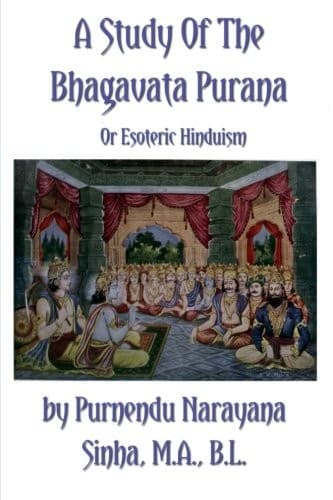
A Study of the Bhâgavata Purâna; or, Esoteric Hinduism
Religion
A Study of the Bhâgavata Purâna; or, Esoteric Hinduism
Puranas. Bhagavatapurana. English
Amidst this diversity of religious ideas and religious observances,
seemingly so contradictory, Sri Krishna, the greatest of all Avatâras,
appeared and He brought the message of peace and reconciliation. He laid
great stress on the fact that the performance of Vedic sacrifices could
lead us only to Svarga Loka, but when our merits were exhausted, we were
bound to be born again on Bhûr Loka, our Earth. While on Earth, we form
fresh Karma, which gives rise to other births. The performance of Vedic
Karma does not therefore free us from the bondage of births, for, as the
Lord said, there is object-seeking in these performances. Object-seeking
for one’s own self does not find a place in the higher Lokas. Its
highest limit is Svarga Loka. So long as man remains self-seeking, he
can not transcend the limits of Trilokî. In the higher Lokas, there is
no recurrence of births and re-births. Once you are translated to Mahar
Loka, you live for the whole of the remaining period of the Kalpa,
passing through a gradual evolution to the higher Lokas. And if you form
a devotional tie with the Lord of many Brahmândas, the First Purusha,
even the Kâlpic period does not restrict your existence. Liberation is a
relative term. It may be from the bondage of births and re-births in
Trilokî. It may be liberation from the bondage of Bvahmandas or solar
systems. Those who worship only material objects remain chained to this
earth. Those who worship the dwellers of Bhuvar Loka (Bhûtas, Pretas,
Pisachas and Pitris) or cultivate aspiration for them become allied to
them and they pass only to Bhuvar Loka after death. Those who worship
the Devas and cultivate this aspiration go to Svarga Loka after death.
Those who worship Hiranya-garbha go up to Satya or Brahmâ Loka. Those
who worship the Lord of all Brahmândas pass beyond even the Brahmânda.
The first thing that a man should do is to transcend the limits of
Trilokî. This he cannot do as long as he is self-seeking. He should
therefore perform his actions _unselfishly_. And the Lord said as
follows: —
1. There is the perishable and the imperishable element in us. Karma or
actions appertain to the perishable element. The perishable element
constantly changes, so it cannot be our real self or Âtmâ. From the
stand-point of our real self, we can dissociate ourselves from our
actions, which relate to our transitory nature. Here the system of
Sânkhya came into requisition.
2. But by this discrimination, we can not forcibly stop the performance
of actions. For the actions are propelled by (_a_) active tendencies
which form an inseparable part of our present nature, and (_b_) by the
necessity of our very existence. So by stopping actions, we force the
tendencies to mental channels, and cause more mischief by producing
mental germs for the future. And we cannot stop all actions, as some are
necessary for our bare existence.
Public-domain text, read in full here on John Shaqi.
Reviews
Reviews
No reviews yet
Be the first to share your thoughts on this work.
Elsewhere in the archive
Join the Discussion
Join the discussion
Sign in to leave a comment or review.
Sign InorCreate an account