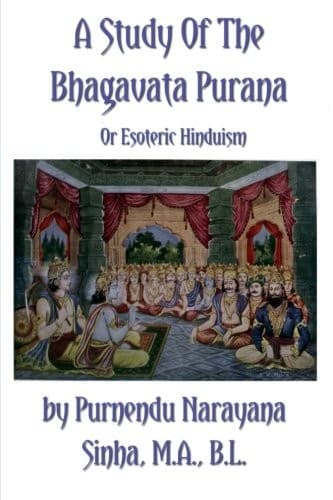
A Study of the Bhâgavata Purâna; or, Esoteric Hinduism
Religion
A Study of the Bhâgavata Purâna; or, Esoteric Hinduism
Puranas. Bhagavatapurana. English
3. Therefore we are to perform actions, and we can perform them
unselfishly, if they are done from a pure sense of duty. We are to take
duty as a law of our very existence. _Yajna_ is only another name for
this law. The Lord of beings, having created all beings with the Yajna,
said of yore, — "You shall prosper by the performance of this Yajna and
this Yajna shall be the producer of all desired objects for you." Yajna
consists of mutual sacrifices, as all beings are dependent on one
another. "Think of the Devas by means of Yajna, and the Devas shall
think of you." All our actions may be classed under duties — duties
which we owe to the Devas, the Pitris, the sages, the animals and to
other men. If we perform our Karma for the sake of Yajna only, we
perform it unselfishly.
4. As discrimination is useful in realising the real self, so restraint
is necessary to put down the acquired self. The tendencies of the
acquired self, if left to themselves, prompt men to ever recurring
actions, which again produce their own effects, some of which develop
into fresh tendencies or strengthen the pre-existing tendencies. So
restraint is to be constantly practised. The object of restraint is to
free the mind from thoughts of the object world and to fix it on the
real self, Âtmâ. Here the system of Patanjali comes into requisition.
But the system is to be accepted with this reservation that Yoga does
not necessarily mean renunciation of Karma. It includes the unselfish
performance of Karma and, for the average humanity, renunciation of
Karma is harmful as an expedient of Yoga. Though there may be some who
do not require Karma for themselves, yet they should not renounce it, if
they want to set an example to others and not to confound their
intellect.
5. But the Pûrva Mimânsâkas say: Vedic Karma is all in all, and the
authority of the Vedas is supreme. Here Sri Krishna had to assert
Himself as an Avatâra, and He asked people to accept His own authority.
He said there was self-seeking in Vedic Karma, and one could not
therefore avoid the recurrence of births by the performance of Vedic
Karma. So Sri Krishna said to Uddhava: — "If the Vedas say that men
attain Svarga by the performance of Vedic Karma, it is simply by way of
inducement, and not as pointing out the supreme end. The father says;
’Boy, eat this bitter medicine and I will give thee this cake in my
hand.’ The boy takes the medicine for the sweet thing. But that really
leads to his recovery from the disease. So the Vedas mean final
liberation as the end. But to enforce restraint, they hold out the
prospect of Svarga, which is most agreeable to men." (Elaboration of XI.
21. 23.)
Many were unwilling to accept the authority of Sri Krishna, and the
chief amongst them was Sisupâla.
Public-domain text, read in full here on John Shaqi.
Reviews
Reviews
No reviews yet
Be the first to share your thoughts on this work.
Elsewhere in the archive
Join the Discussion
Join the discussion
Sign in to leave a comment or review.
Sign InorCreate an account