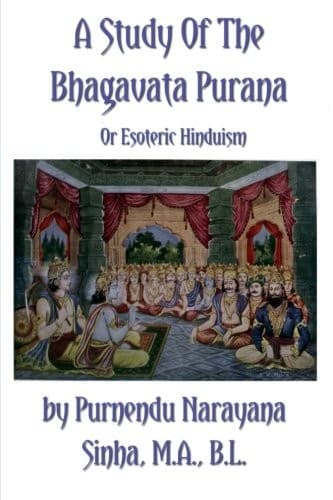
A Study of the Bhâgavata Purâna; or, Esoteric Hinduism
Religion
A Study of the Bhâgavata Purâna; or, Esoteric Hinduism
Puranas. Bhagavatapurana. English
"Even before this, the Lord knew about the grievances of the goddess of
Earth. Go, take your births, as parts of yourselves, in the clan of the
Yadus. The Lord of Lords, by governing His Kâla Śakti, shall appear on
the Earth and relieve her pressure. The Supreme Purusha Himself shall be
born in the family of Vâsudeva. Let the Deva girls take their births for
His gratification. The thousand-mouthed, self-illumining Ananta, who is
only a part of Vâsudeva, shall be the elder-born, that he may do what
pleases Hari. Bhagavati, the Mâyâ of Vishnu, who keeps the whole world
under delusion, shall also incarnate in part, as desired by the Lord,
for doing His work."
Saying all this to the Devas, and giving words of consolation to the
goddess of Earth, Brahmâ went back to his own abode.
Śura Sena, the chief of the Yadus, ruled over the town of Mathurâ. Hence
it became the chief seat of the Yadu kings. It is a sacred town, the
constant seat of Hari.
Once upon a time, at Mathurâ. Vâsudeva drove in his chariot with his
newly married wife Devaki. The marriage presents were innumerable.
Kansa, the son of Ugrasena, held the reins of the horses himself, so
eager was he to please his sister Devaki.
On the way, an incorporeal voice, addressing Kansa, said: —
"O ignorant one! the eighth child of her whom thou art now driving shall
be thy slayer."
The cruel Kansa instantly took sword in hand and caught Devaki by her
hair.
Vâsudeva pacified him with these words: —
"Thy virtues are well known. Why shouldst thou kill a female, thine own
sister, at marriage. Death is certain, this day or a hundred years
hence. Man takes body after body under the action of Karma, as he takes
step after step in walking, or even as the leech takes blade after blade
of grass in moving.
"As in dream there is a reflex perception of what is seen and heard in
waking, and as in that perception the man forgets his former self and
becomes a reflex of that self, so a man gives up his former body and
becomes forgetful of it.
"To whatever body the mind is drawn by fruit — bearing Karma, the Jiva
assumes that body as its own.
"The wind shakes the water and the Son or moon, reflected on its bosom,
appears as if shaken. So by ascription, the Purusha has the attributes
of the body. He who does evil to another has to fear evil from others.
"This girl, thy younger sister, is motionless with fear. Thou art not
entitled to kill her."
But persuasion was of no avail, as Kansa was under the influence of the
Daityas.
Vâsudeva then thought how he could ward off the present danger, leaving
the future to take care of itself.
Addressing Kansa he said: —
"But, O King, thon hast no fear from her: Surely I would make over to
thee her sons, from whom thou hast fear." Kansa desisted from his cruel
act and Vâsudeva went home with his bride, pleased for the time being.
In time Devaki brought forth eight sons and one daughter.
Public-domain text, read in full here on John Shaqi.
Reviews
Reviews
No reviews yet
Be the first to share your thoughts on this work.
Elsewhere in the archive
Join the Discussion
Join the discussion
Sign in to leave a comment or review.
Sign InorCreate an account