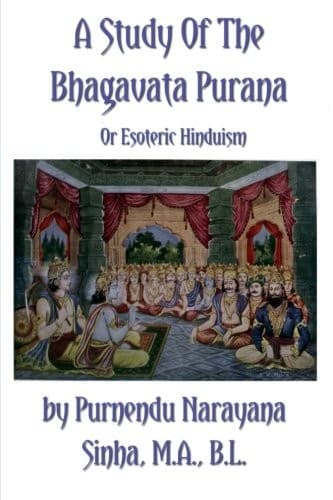
A Study of the Bhâgavata Purâna; or, Esoteric Hinduism
Religion
A Study of the Bhâgavata Purâna; or, Esoteric Hinduism
Puranas. Bhagavatapurana. English
(i.) — _The manifestation in the heart._ — A detailed knowledge of this
manifestation is called Dahara Vidyâ in Chandogya. The Upanishads speaks
of Âtmâ in the cavity of the heart.
"Guhahitam Gahvarestham Purânam" is a well-known passage from the
Upanishads. The Purusha in the heart is also called Prâdesâ or the
span-sized Purusha and is the favourite object of meditation in
Paurânika Upâsanâ. The Upanishads call Him thumb-sized and there is an
interesting discussion as to the size in Sâriraka Sutras I-3-24 to 26
and the Bhâshya thereupon.
(ii.) — _The Manifestation in the Prânas._ — The Upanishads say: —
"It is this Prana that is consciousness itself, Bliss, without
infirmities and death."
"They are these five Brahmâ Purushas."
Again —
_"Brahmâ Purusha in the openings of the heart."_ The heart is called the
abode of Brahmâ. There are five openings of this abode of Brahmâ and
there are five gate-keepers. These gate-keepers or _dvâra-pâlas_ are the
five Prânas. They are called Brahmâ Purushas as they pertain to Brahmâ.
As long as the king is in the heart, the doorkeepers remain in the body.
These door-keepers being inevitable accompaniments of Brahmâ in the
heart, are also themselves the outer aspects of Brahmâ.
(iii.) — _The manifestation as Âtmâ which is triune._ What is a man but
a bundle of experiences on the planes of Jâgrat, Svapna and Sushupti.
Each of these experiences has a threefold aspect or in Vedântic
expression is a Triputi. These aspects are:
1) the object experienced or Adhibhûta,
2) the experience itself or Adhyâtma,
3) and the Deva which gives the consciousness of that experience or
Adhidaiva.
In material expression, the object outside is Adhibhûta. The reception
of its image is Adhyâtma. The light that shews the image to be what it
is, is Adhidaiva. As we have said, each experience is a three-sided
triangle. All the triangles in the Jagrat state, analysed by the
Vedântins into fourteen, are represented by the first letter _a_ in
Pranava. All the triangles or Triputis in the dream state are
represented by the second letter _u_. In Târaka Brahmâ Yoga, _a_ is
merged in contemplation into _u_, and _u_ is merged into _ma_. In _ma_
there is only one triangle, which is the primary triangle to which all
other triangles in _a_ and _u_ may be reduced. The Adhibhûta side of
this triangle is _ânanda_ by the _vritti_ of Avidyâ. The Adhyâtma side
is the _vritti_ of Avidyâ. The Adhidaiva side is Íshvara. Life in
Trilokî is conditioned by this triangle. The object of Târaka Brahmâ
Yoga is to cross the Triptiti, to cross the three letters of Pranava. It
is only in the fourth _pâda_ of Pranava that he finds his resting place,
that pâda being situated beyond the Trilokî.
Public-domain text, read in full here on John Shaqi.
Reviews
Reviews
No reviews yet
Be the first to share your thoughts on this work.
Join the Discussion
Join the discussion
Sign in to leave a comment or review.
Sign InorCreate an account