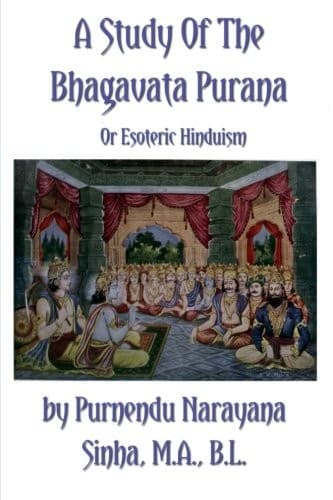
A Study of the Bhâgavata Purâna; or, Esoteric Hinduism
Religion
A Study of the Bhâgavata Purâna; or, Esoteric Hinduism
Puranas. Bhagavatapurana. English
The Gopas asked Krishna for the milk-products. As devas, they had never
known such offerings in Yajnas. They informed Krishna, where the milk
made things were to be found. (XXIII and XXIV.) For the gratification of
the universe, the longings of Krishna are great and for this reason he
did not spare any fresh butter of the Gopis. The Gopis learned from this
that for the bare up-keep of their lives, they were to attend to their
household duties (XXVI). (If the boys are to steal away all the butter,
life itself will be extinguished. People should have enough left for
their household requirement. If I taste only a little of the butter, all
the three Lokas will be gratified, and the Gopis will acquire the merit
thereof. Considering all this, Bhagavân tasted butter by stealth
_Nilkantka_. This means, in so many words, that Krishna accepted the
fruits of all the actions of the Gopis except such as sufficed to
preserve their lives). The Gopis complained to Yasodâ of the stealing
acts of Krishna. XXVII.
_Vrindâvana Kânda_.
The dwellers of Gokula migrated with Krishna to Vrinddvana, for fear of
Vrikas or wolves. (Kâma and other passions are the wolves, _Nitkantha_),
I.
In treating of Pralamba Asura, mention is made of the nonperception of
"I am Brahmâ," VII.
Pralamba is said to be an aspect of the primal Daitya Madhu, IX.
There is some philosophical discussion about the concealment of calves
by Brahmâ, (X to XIV.)
The first six sons of Devaki are the Six Indriyas (including Manas) and
the seventh is the Jivâtma, the conscious Ego. XXXV.
In commenting upon this sloka, Nilkantha says, "Devaki and other names
are merely allegorical, bearing an esoteric meaning. The narration is
not the real point." He further supports his position while commenting
on sloka XL, of Vrindâvana Kânda. He makes quotations from the Skanda
Purâna, which speak of the twofold meanings of the narration texts, one
Âdhyâtmika and another Âdhi bhautika, the former being difficult to
follow. Following up these quotations, Nilkantha says; "Those that are
not prepared for the Âdhyâtmika hindering of all modifications of the
mind, must seek the Âdhibhautika Lilâ of Bhagavân. And if they
concentrate their minds on the _holy deeds of Bhagavân_, they acquire
the result of Samâdhi."
Krishna is Paramâtmâ. The intercourse of the Gopis was not therefore
adulterous. (XXXVII and XXXVIII.)
_Akrûra Kânda_.
In this Kânda, Akrûra comes to Vraja and takes Râma and Krishna to
Mathurâ.
_Mathura Kânda_.
This part treats of the killing of Kansa by Krishna.
Krishna is described as the knower of the hidden names of the cows. (It
is to be understood that the cows have hidden names, _Nilkantha_.)
We now come to KRISHNA UPANISHAD, one of the Atharvana Upanishads.
The Gopas are Devas.
"Nanda" is Supreme bliss.
"Yasodâ" is Mukti.
Mâyâ is three-fold Sâtvika, Râjasika and Tâmasika.
Satvika Mâyâ is in Rudra, Râjasika in Brahmâ and Tâmasika in the
Daityas.
Public-domain text, read in full here on John Shaqi.
Reviews
Reviews
No reviews yet
Be the first to share your thoughts on this work.
Elsewhere in the archive
Join the Discussion
Join the discussion
Sign in to leave a comment or review.
Sign InorCreate an account