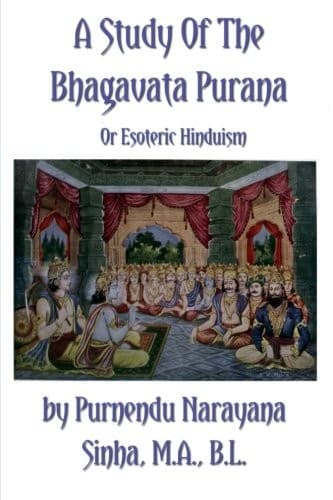
A Study of the Bhâgavata Purâna; or, Esoteric Hinduism
Religion
A Study of the Bhâgavata Purâna; or, Esoteric Hinduism
Puranas. Bhagavatapurana. English
The Puri of Mathurâ is in every man, the kingdom of his own mind, where
the personal self is to be _put down_. Mathurâ is from _math_, to put
down. Lavana (Salt), the demon of materialism (for salt is an emblem of
materialism; cf. the salt ocean) had hold of this Puri during the time
of Râma, and Satrughna killed the demon.
But materialism regained its lost ground and the forces of descent
gathered strong round Kansa. Kansa was Kâla-nemi, or the mark left by
the wheel of time. Each one of us has inherited through countless ages a
strong element of materiality, which tries to reign over each one of us.
This is the Kansa in each of us. There was also king Kansa of the period
when Krishna appeared. He was brought down from his high platform and
killed by Krishna, and the spiritual evolution of humanity became
assured.
There are eight Prâkritic principles in man, corresponding to eight
senses. Earth or smell, water or taste, fire or form, air or touch, and
akasa or sound, these enable Jivas to acquire experiences from the
outside. Ahankâra, or the sense of egoism, enables man to assimilate
those experiences to his personal self, and to make a small world of his
own self.
Then there is Mahat and the universal sense corresponding to it. This
sense takes man out of the limits of personality; it raises him to the
level of spiritual life. It develops unselfishness and universal life.
Last of all is the eighth principle, Mula Prakritî. It gives the sense
of perceiving Âtmâ.
Krishna helps the evolution of the Jivas, by developing the outer senses
first and then the inner senses.
When the first six senses are developed, the evolution of personality is
complete. The powers that develop the senses do not come any more into
requisition. Those powers were the first six brothers of Krishna, who
lay slumbering in the ocean, and who were _ardhagarbha_, as Harivansa
says. Their action was confined to the material stage of evolution and
hence they are said to have descended from Hiranyakasipu. Kansa had no
difficulty in slaying these half-dead powers.
The sixth brother was Balarâma. He was robed in blue, a highly spiritual
color, the color of Mahat. He roused the spiritual sense of man. Jivas
had wandered away from their spiritual home, where they were all united,
and each had made a separate entity for himself. Balarâma tried to draw
them together once more on the plane of Mahat. Hence he was called
Sankarshana, and his instrument was called the plough. He was the first
born, as men cannot come face to face with Íshvara, so long as they are
not raised beyond the limits of personality. Jivas streamed forth from
the plane of Mahat, presided over by Atlanta or Sankarshana, and they
are drawn back to that plane so that they may set out on a higher
spiritual journey.
Public-domain text, read in full here on John Shaqi.
Reviews
Reviews
No reviews yet
Be the first to share your thoughts on this work.
Elsewhere in the archive
Join the Discussion
Join the discussion
Sign in to leave a comment or review.
Sign InorCreate an account