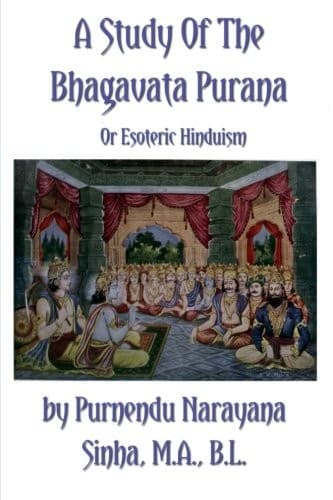
A Study of the Bhâgavata Purâna; or, Esoteric Hinduism
Religion
A Study of the Bhâgavata Purâna; or, Esoteric Hinduism
Puranas. Bhagavatapurana. English
The husk-stand is the discriminating faculty, that which separates the
husk from the grains. When Krishna becomes fastened to the
discriminating faculty (not that any one can fasten him with any effort
of his own), when right and wrong are centered in him, self becomes
abnegated and offered up entirely to Krishna, Egoism and ignorance, the
pair of Arjuna trees disappear, though deeply rooted in man (X. 10).
When fruits are offered to Krishna, there is a rich return (X. 11.).
We have reached here a point in spiritual progress. Personality has been
completely given up. Brain intellect is no longer congenial to spiritual
progress. The head retards the spiritual man and does not carry him
forward.
The elders of Gokula sat in council and they decided to leave Gokula for
Vrindâvana.
Vrindâvana is the Heart. The eight-petalled lotus in the heart is the
permanent abode of Sri Krishna. The twelve forests are twelve centres 4
x 3, the primary number being 4, the number of the sacred Tetraktys.
Within the heart, the only Purusha is Sri Krishna. AH others have to
make themselves passive to Him. The Gopis, the ideal devotees of the
Purusha in the heart, left the world outside, their husbands and homes,
and placed themselves entirely at the service of the Divine Lord. Let us
approach the sublime truths of the Vrindâvana Upâsanâ with the utmost
solemnity possible. Those who cannot bring themselves to an exalted
appreciation of the Vrindâvana Lilâ had better not read the Bhâgavata at
all.
The Gopas and Gopis went to Vrindâvana. Râma and Krishna headed the Gopa
boys and looked after the calves.
What are the cows and calves? Who are the Gopas, the Gopa boys and the
Gopis?
Once more let us understand the triad — Adhyâtma, Adhibhûta and
Adhidaiva. Take sight.
The sense of sight comes in contact with the outside world and carries
the perception of sight to the possessor of the eye, under the guidance
of a conscious energy. The senses and the mind are Cows or Adhyatma. The
outside world is grass or Adhibhûta. The possessor of the senses and the
mind is the Gopi, the Ego or Jiva. In Vrindâvana, the Gopis are the
highest Jivas or Rishis, as explained in the Upanishads. The conscious
energy is the Gopa or Adhideva.
The Adhidevas are the Vedic Devas, as we have already seen.
The Gopas are reincarnations of the Devas, as explained in the
Upanishads.
Ordinarily the Gopas lead the cows or the Adhi-Davas lead the senses,
but in Vrindâvana the Devas surrender themselves entirely to Krishna.
The calves or the Vatsas are the modifications of the senses and the
mind — the Vrittis.
In Vrindâvana, Râma and Krishna first tended the calves. The Gopa boys
were the attendants of Râma and Krishna, the pârishads or companions who
reached very near the state of divinity, the work-mates of Bhagavân in
the preservation of the universe.
The Lord tended the Vrittis of the mind. Therefore they could not go
astray.
Public-domain text, read in full here on John Shaqi.
Reviews
Reviews
No reviews yet
Be the first to share your thoughts on this work.
Elsewhere in the archive
Join the Discussion
Join the discussion
Sign in to leave a comment or review.
Sign InorCreate an account