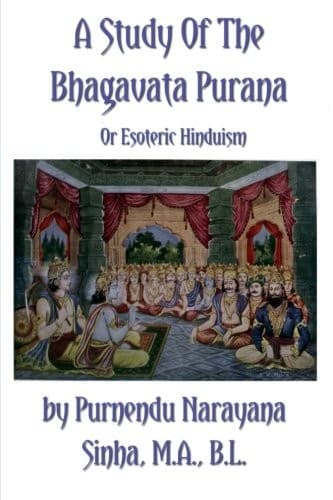
A Study of the Bhâgavata Purâna; or, Esoteric Hinduism
Religion
A Study of the Bhâgavata Purâna; or, Esoteric Hinduism
Puranas. Bhagavatapurana. English
Nanda is bliss, he is spiritual Bliss the Bliss of an Antar Mukha. It is
spiritual bliss that attracts spirit unto itself. It is the field for
spiritual growth, the nursery ground of enthusiastic devotion and, what
is more, of devotional love. The ideal spiritual bliss is that of
Râdhikâ and of her fellow Gopis. It is the Bliss aspect of Ísvara that
in the Jiva causes mutual attractions and makes devotion a law, a
necessity. Reflected in the Universe at large, it is the one bond that
holds together all beings, and becomes a force of attraction on all
planes. Man is guided by bliss in his relations to the Universe. He is
guided by bliss in his relation to himself.
Nanda is located in the brain, in the thousand-petalled Lotus. The
spiritual seat in the head is Gokul, the first abode of Nanda.
Krishna appears in Gokul. The devotee sets out on his devotional
journey.
The first impediment of a devotee is Mala or impurity. In spite of
himself, he cannot get the better of his passions, his personal desires.
They have such a strong and apparent charm, there is such an hereditary
and accumulated attraction toward them, that they easily overcome the
devotional life in its infancy. The fascinating Pûtanâ overtook all by
her charms and she found an easy access to Krishna himself. She made an
attempt to nurse Krishna with poisoned milk. She was killed and Mala was
removed (X. 6.)
The next impediment is Vikshepa or distraction. The mind, with its load
of outside experiences always responding to the outside world, is so
much distracted, thinking now of this and now of that, that it has to be
set right before further development is possible. The cart has to be
upturned, with its load of food-articles, the cart of mind with its load
of experiences. That is, the man has to become Antarmukha (X. 7.) When
this is done, the Asura of distraction, Trinâvarta or whirlwind, is
easily killed (X. 7.). The Gopis were now void of impurities and void of
distraction; yet more they were being attracted to Krishna. Krishna
favored them by stealing the fruits of their karma or action and
accepting them for himself. Sri Krishna said to Arjuna, "You have a
right to the Karma only and not to the fruits thereof." The senses of
the Gopis used to roam about in the performance of daily duties, and
they brought back perceptions and conceptions for the day which were
worked out by the Gopis as duty required. The perceptions and
conceptions are the milk-products and milk. They were churned into the
karma of the Gopis. The senses are the cows; the outside objects of
perception, their grass. The Brahmâ Vaivarta Purâna says: — "_Ghrita_ is
obtained from milk, _Yajna_ is performed with _Ghrita_, and all
happiness arises out of the performance of Yajna." _Prakriti Khanda_.
The preparation of milk products is the karma or sacrifice of the Gopis.
(X. 8.).
Public-domain text, read in full here on John Shaqi.
Reviews
Reviews
No reviews yet
Be the first to share your thoughts on this work.
Elsewhere in the archive
Join the Discussion
Join the discussion
Sign in to leave a comment or review.
Sign InorCreate an account