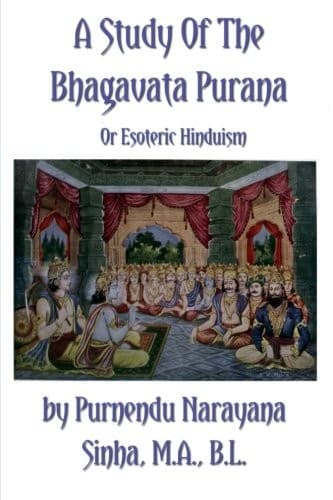
A Study of the Bhâgavata Purâna; or, Esoteric Hinduism — John Shaqi
A Study of the Bhâgavata Purâna; or, Esoteric Hinduism
Religion
A Study of the Bhâgavata Purâna; or, Esoteric Hinduism
Puranas. Bhagavatapurana. English
The Kumâras form a peculiar creation. "They are Prakrita in as much as
they partake of the character of Devas and they are Vaikrita, as they
partake of the character of men." _Śridhara._ — The great commentator
also says: — "Sanaka and other Kumâras are not created in every kalpa.
The account of their creation is only given in the first Kalpa, called
Brahmâ. In reality, the Vegetable and other life kingdoms are created in
every Kalpa. Sanaka and others being created in Brahmâ Kalpa only follow
the creations in other Kalpas."
Upon death, men go to Bhuvar Loka, where they become Bhûtas, Pretas and
Pisâchas. Then they go to Svar Loka, where they become Devas, not the
Devas of Deva creations but only temporary Devas. When their merits are
exhausted, they come down upon earth, to begin life as men again. But if
by unselfish Karma and devotion, men pass across the limits of the
triple plane, they go first to Mahar Loka. Here they are called
Prajâpatis. Bhrigu and other Prajâpatis who are the ordinary dwellers of
Mahar Loka, are described in one sloka of Bhâgavata, as bearing the life
period of one Kalpa. (II. 2. 25). In the next sloka it is said that the
Yogins who go to Mahar Loka, remain there till the end of the Kalpa,
when at last they go to Satya Loka.
But in another sloka, the Purâna says: — "When the night of Pralaya
follows, the three Lokas, Bhûr, Bhuvar and Svar, are burnt by the fire
from the mouth of Sankarshana. Troubled by the excessive heat of that
fire, Bhrigu and others proceed from Mahar Loka to Jana Loka."
III-11-30.
This shews that the dwellers of Mahar Loka live for the life time of
Brahmâ or two Parârdhas.
This is also made clear by the following commentary of Śridhara on
III-10-9: —
"Why did Brahmâ make the three Lokas into one division? This Trilokî
consisting of Bhûr, Bhuvar and Svar — is the place that is to be made in
every Kalpa or day of Brahmâ for the enjoyment of Jivas (or
individuals). But Jivas dwell in the higher Lokas as well. Why are not
those Lokas created then in every Kalpa? This is because they are the
transformations of unselfish (Nishkâma) action or Dharma — the Lokas
themselves and the dwellers thereof. The Trilokî and the dwellers
thereof are the transformations of selfish (Kâmya) action. Therefore
they have birth and death in every Kalpa. But Mahar and other Lokas are
begotten by unselfish action heightened by Upâsanâ (or devotion), and
they last for two Parârdhas, which is the life time of Brahmâ. And the
dwellers of those Lokas generally attain mukti (or liberation) after
that period."
The ordinary dwellers of Jana Loka are the Kumâras. When men in course
of evolution reach Jana Loka, they become Kumâras.
Public-domain text, read in full here on John Shaqi.
Reviews
Reviews
No reviews yet
Be the first to share your thoughts on this work.
Join the Discussion
Join the discussion
Sign in to leave a comment or review.
Sign InorCreate an account