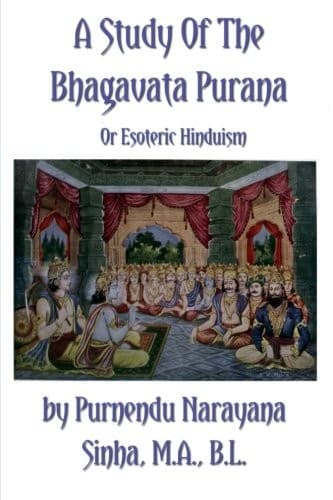
A Study of the Bhâgavata Purâna; or, Esoteric Hinduism
Religion
A Study of the Bhâgavata Purâna; or, Esoteric Hinduism
Puranas. Bhagavatapurana. English
Now it was time for Sri Krishna to appear, the greatest of all Avatâras
in our Kalpa, Who gave the last bent to the progress of humanity. He
wedded Himself with all the principles that enter into the constitution
of man, so that man may come up to Him. He taught the basic unity of all
beings, and laid down the path of Service and Devotion. He established
the reign of spiritual life, and ever since His lotus feet sanctified
the soil of India, the Scriptures only re-iterate His teachings, and
they all sing His glory for ever and ever. We shall find in its true
place the Service done by Lord Sri Krishna, and how by His Avatarship
humanity has made one more advance in the scale of human evolution. When
the Lord appeared, Bhagavatî made her appearance too as the daughter of
Nanda. It is with Her energy that Sri Krishna performed the mission of
His Avatarship.
This is a bare outline of what the Tables teach us, We shall consider
them each in its own place. We shall find a detailed account as to how
the Universe is preserved. We shall hear of great Rishis, of many
Avatâras, of the part played by Devas and Asurus. We shall see how the
Monads pass through different stages of evolution, till the idea of
perfect humanity is presented by Lord Krishna.
The Tables sometimes speak of life Kingdoms, sometimes of human races,
sometimes of types and principles, and sometimes of individuals.
Sometimes, the names used convey a good deal of hidden meaning,
sometimes they are used at random.
In the line of Priyavratra, we find how globes are formed, how
continents and countries appear. The solidification of earth is
indicated by the muteness of Bharata. Bhârata Varsa or India is called
the first born of all countries, and other lands are enjoined to follow
and to obey their eldest brother.
TABLE A.
*SKANDHA IV. CHAP. 1.*
The names of the first table have been considered before.
TABLE B.
*SKANDHA IV. CHAP. 1.*
Ruchi and Akuti both mean Wish, Desire. Yajna is sacrifice, Dakshinâ
means ordinarily the present made to a Brâhmana for officiating at a
ceremony. It is also the present made for the performance of a Vedic
sacrifice. No Vedic sacrifice is complete without the present of
Dakshinâ to the officiating priest. Dakshinâ was married to Yajna, for
they are inseparable. Possibly Yajna has reference to the elemental or
Devic character of life forms in the first Manvantara. That also
explains why there was no Indra separate from the Avatâra of the
Manvantara.
The first Manvantara was one of Pravritti or Descent, Spirit could
descend into matters only with the help of Desire. Desire is the father
of Kâma — Kâma is the characteristic of Vedic Yajna. Yajna therefore
guided the First Manvantara. He was the Avatâra of Vishnu as well as the
Indra of the Devas.
Public-domain text, read in full here on John Shaqi.
Reviews
Reviews
No reviews yet
Be the first to share your thoughts on this work.
Elsewhere in the archive
Join the Discussion
Join the discussion
Sign in to leave a comment or review.
Sign InorCreate an account