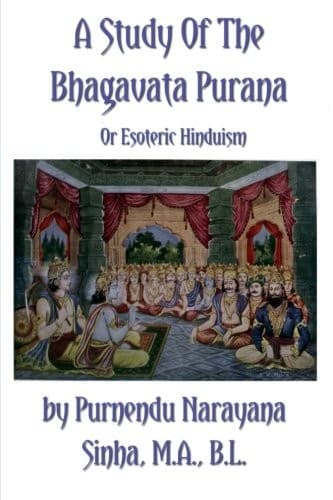
A Study of the Bhâgavata Purâna; or, Esoteric Hinduism
Religion
A Study of the Bhâgavata Purâna; or, Esoteric Hinduism
Puranas. Bhagavatapurana. English
All rose up and saluted Him. Spontaneous prayers broke forth from one
and all. Vishnu participated in the Yajna offerings. Addressing Daksha
He said: — "Only ignorant people see the difference between Me and Śiva.
I, Śiva and Brahmâ are Three in One. For the creation, preservation and
dissolution of the Universe, We assume three different Names. We, as the
triune Âtmâ, pervade all beings. Wise men therefore look upon all others
as their own selves."
Such is the story of Sâti’s death. She took birth again as the daughter
of Himâlaya and became wedded once more — the union with Śiva this time
was permanent.
THOUGHTS ON THE ABOVE.
Brahmâ, Vishnu and Śiva are the three aspects of the Second Purusha.
Brahmâ brings into manifestation the Prajâpatis, and the Prajâpatis
bring into manifestation the individuals and life forms. The other
Prajâpatis mostly represent the principles that enter into the
constitution of life-forms, while Daksha represents the combination of
principles forming a life unit.
Daksha had sixteen daughters — thirteen he gave in marriage to Dharma,
one to Agni, one to the Pitris and one to Śiva.
Agni or the god of Fire is the Rupa or form-giving Deva. Fire is used in
sacrifice, because it changes the form of things offered and makes them
acceptable to the gods by change of form.
If Agni represents Rûpa Devas or Devas with forms, Dharma might
represent Arûpa Devas or Devas without forms.
The Pitris, of whom four classes are only mentioned (Agnishvâtvas,
Barhishads, Saumyas and Ajyapas), are also divided into two classes, —
one with fire and one without fire.
The attendants of Śiva were dwellers of the astral or Bhuvar plane.
For the sake of convenient reference we shall call the dwellers of
Svarga Loka Devas and the dwellers of Bhuvar Loka, Astrals. The
different classes of Devas and Astrals are described in the 20th.
chapter of the 4th. Skandha. The Devas and Astrals were brought into
manifestation by Daksha, whose position in creation was next to that of
Brahmâ. Therefore all stood up to receive him at the sacrifice except
Brahmâ.
Śiva first appeared as Kumâra Nîla Lohita or Rudra. And all beings
thereafter got the potentiality of dissolution, phenomenal change, death
and decay. But in the first stage of life process, phenomenal change,
decay or dissolution was not in requisition, as Monads went on in their
downward journey, not by dissolution, but by evolution. They remained
what they were, and they acquired in addition a more material form. As
the material form became prominent the Deva form and the astral form
became suppressed.
Consciousness in Deva form manifests itself as mind, in the astral form
as animal desire and sense perception. In the mineral form it can hardly
shew itself.
Public-domain text, read in full here on John Shaqi.
Reviews
Reviews
No reviews yet
Be the first to share your thoughts on this work.
Elsewhere in the archive
Join the Discussion
Join the discussion
Sign in to leave a comment or review.
Sign InorCreate an account