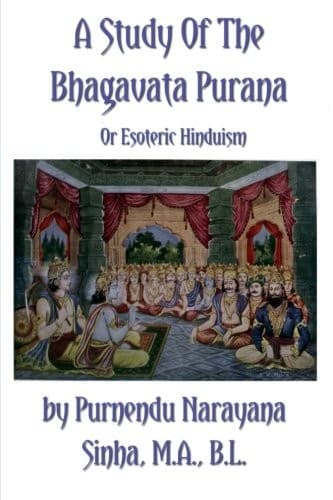
A Study of the Bhâgavata Purâna; or, Esoteric Hinduism
Religion
A Study of the Bhâgavata Purâna; or, Esoteric Hinduism
Puranas. Bhagavatapurana. English
Śiva works out the decay and dissolution of mineral matter, so that the
astral element may once more assert itself and there may be sense
perception in the mineral metamorphosed into the vegetable. The process
is carried further in the animal kingdom, and the animals get a
constitution in which Kâma or animal desire can manifest itself. The
animals evolve themselves by death. Death frees them from the trammels
of one set of experience, and carries them onwards till the human body
is reached.
The work of dissolution proceeds in various ways. Our sleep is partial
dissolution. It is brought on by the astral attendants of Śiva.
Dissolution is caused by Tamas. Tamas begets inaction, and inaction
causes death and decay. There is no phenomenal change without
dissolution, death or decay.
There are so many material tendencies in us that they require rejection.
Śiva gives us the power of rejection, as Vishnu, the power of
preservation — preservation of all that is good in us. Death makes the
man, where moral teachings fail, The Consort of Śiva is the Energy
through Whom He guides the life process of Monads or Jivas. In the first
stage of life process She is called Sâti or the Lasting. For the body of
the Jiva was lasting during the period of evolution. But Her mission was
to act on the Monad itself, to cause the material tendency in it by
means of Tamas.
In the second stage, She is the Energy of dissolution, death and
phenomenal change. In the third stage, she is over and above that the
Energy of rejection (of all that is evil in us.) She is the kind mother,
who has been nourishing all Jivas in their course of evolution.
When the Mineral form was reached by the primal elemental Jiva, the
creative process had done its work and the process of dissolution was to
assert itself. There was to be a revolution in the life process. Sâti
gave up her own nature and became re-born in another character in the
Mineral Kingdom. The creative process was materially changed. Daksha
lost his original head, and he acquired the head of a goat. The goat
symbolises sexual connection. All this happened during the reign of
Prâchina-Barhis. The Prachetas brothers were his sons. Daksha reappeared
as the son of the Prachetas brothers.
The Âdityas or gods of preservation who formed Daksha were Pûshava and
Bhaga. They were the preserving deities of the first stage of life
process. When the next stage came in, they lost their activity. This
explains the breaking of teeth and the uprooting of eyes of two of the
Âdityas. The subjoined Table of correspondences taken from the 11th.
Chapter of the Twelfth Skandha shews that Pûshana and Bhaga correspond
to the months of Pausha (December) and Mâgha (January) when the rays of
the sun are the least powerful. These Âdityas preserve Jivas in their
downward course. Pûshana was a favorite god of the Aryan shepherd.
Public-domain text, read in full here on John Shaqi.
Reviews
Reviews
No reviews yet
Be the first to share your thoughts on this work.
Elsewhere in the archive
Join the Discussion
Join the discussion
Sign in to leave a comment or review.
Sign InorCreate an account