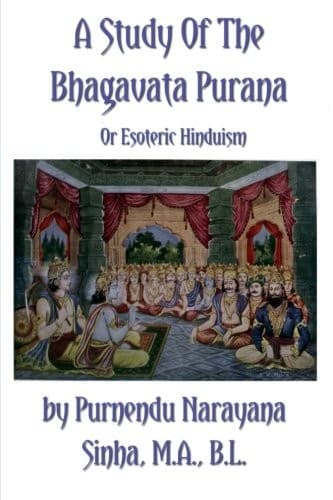
A Study of the Bhâgavata Purâna; or, Esoteric Hinduism
Religion
A Study of the Bhâgavata Purâna; or, Esoteric Hinduism
Puranas. Bhagavatapurana. English
The Yavana troops of King Fear under Prajvâra and the daughter of Kala
attacked the Puri of Puranjana. The old serpent gave way. The Puri was
burnt up by Prajvâra. There was wailing all round. The Serpent left the
Puri. Puranjana was dragged out of it. The sufferings he had caused to
others in sacrifices or otherwise reacted upon him. Long he suffered
forgetting even his old friends. His mind had been tainted by the
constant company of women and he had thought of his wife till the last
moment. So he became a female in the next birth. She was born as the
daughter of the Vidarbha king. Malayadhvaja, King of Pândya, defeated
other princes in the fight for her hand and the princess became his
wife. She bore to the King one black-eyed daughter and seven sons. The
sons became kings of Dravida and each of them had millions of sons,
Agastya married the daughter of the King, and had by her a son called
Dridhachyta. His son was Idhmavâha. King Malayadhvaja divided the
kingdom amongst his sons; and ascended the hills for devotional
meditation. His wife accompanied him. One day the princess found the
body of her husband cold in death. With loud lamentations, she prepared
the funeral pyre, placed the King’s body upon it and put fire thereon.
She then resolved to burn herself on the same pyre.
The former friend now appeared. Addressing the Queen he said: —
"Who art thou? Who is he lying on the funeral pyre that thou mournest
aloud? Dost thou know me, thy friend, thy former companion? Dost thou
remember even so much that thou hadst a friend, whom thou canst not
recognise? Thou didst leave me in search of some earthly abode and
enjoyment. We were two Hansas (swans) on the Mânasa Loka and we lived
together for one thousand years. Desirous of worldly enjoyments thou
didst leave me for the earth and there didst find a town with a woman as
its mistress. The company of that woman spoiled thy vision and effaced
thy memory. Hence thou hast attained this state. Thou art not the
daughter of the Vidarbha King, nor is this King thy husband. Nor wast
thou the husband of Puranjana. By my _mâyâ_ thou misconceivest thyself
as a man or a woman. But in reality both myself and thyself are Hansas.
Wise men find no difference between us. If there is any difference
between a man and his image, that is the difference between me and
thyself."
The other Hansa now regained his lost consciousness and was reawakened
to his former state.
This is the story of Puranjana. Now its explanation by Nârada: —
Puranjana is Purusha — he who illumines the Pura with consciousness.
The unknown friend is Íshvara.
The Pura or Puri or town is the human body.
"The marks were all favourable" — there were no deformities in the body.
"The nine gateways" are the nine openings of the body.
The young lady Puranjani is Buddhi.
She is the mistress of the body.
The ten male attendants are the five _jnanendriyas_ or organs of
perception and the five _karmendriyas_ or organs of action.
Public-domain text, read in full here on John Shaqi.
Reviews
Reviews
No reviews yet
Be the first to share your thoughts on this work.
Elsewhere in the archive
Join the Discussion
Join the discussion
Sign in to leave a comment or review.
Sign InorCreate an account