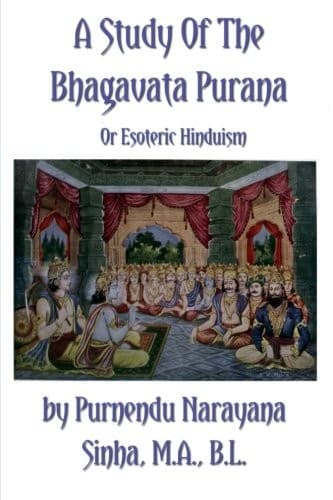
A Study of the Bhâgavata Purâna; or, Esoteric Hinduism
Religion
A Study of the Bhâgavata Purâna; or, Esoteric Hinduism
Puranas. Bhagavatapurana. English
The wives of the attendants are the functions of the Indriyas.
The five-headed serpent is Prâna. The five heads are its five
sub-divisions.
"One hundred years" is the full term of man’s life.
"Khadyota," literally glow-worm, is the left eye, for, it has not the
illumining capacity of the right eye.
"Âvirmukhi" or the great illuminator is the right eye.
"Vibhrajita" is Rûpa or object of sight.
"Dyumat" is the perceiving eye.
"Nalini" and "Nâlini" are the left and right nostrils respectively.
"Avadhûta" is Vâyu. In the story, it means the perceiving nose.
"Saurabha" is Gandha or smell.
"Mukhya" is mouth.
"Apana" is speech.
"Bahûdana" is eating.
"Panchâla" is Pancha (five) + ala (capable) that which is capable of
bringing to light such of the five objects of the senses, as cannot be
otherwise cognised; Śastra or spiritual teachings.
The right ear is stronger than the left ear. Therefore it is more
prominent and useful in _hearing_ the Śastras, of which the first to be
heard is Karma Kânda.
A man by the observance of Karma Kânda is called to the Pitris, _i.e._
he reaches, after death, the path called Pitriyâna.
"Pitrihû" is therefore the right ear. "Devahû" is the left ear
corresponding to Devayâna.
"Uttara Panchâla" is Pravritti Śâstra or teachings of worldliness.
"Dakshinâ Panchâl" is Nivritti Śâstra or teachings of renunciation.
"Nirriti" is death. The anus is called death, because ordinarily the
Linga Sarira goes out through that passage after death.
"Lubdhak" is Pâyu.
"Vaisasa" is excrement.
"Nirvâk" is foot.
"Pesaskrita" is hand.
Of the Indriyas, hand and foot are blind, as there are no openings in
them.
"Vishûchina" is mind.
Moha is the result of Tamas, Prasâda of Satva and Harsha of Rajas.
The aforesaid names indicate enjoyment in the Jâgrat or waking state.
The hunting represents enjoyment in the Svapna or dream state.
The "Chariot" is the body in dream consciousness.
The five horses are the five organs of perception.
The two poles are "I-ness" and "Mine-ness."
The two wheels are merit and demerit.
The axle is Pradhâna.
The three flags are the three Gunas.
The five chains are the five Prânas.
The bridle is Manas the seat of desires.
The charioteer is Buddhi.
The yoke-ends are sorrow and delusion.
The seven fenders are the seven Dhâtus or essential ingredients of the
body.
The five courses are the five organs of action.
The gold color of the armour is due to Rajas.
Brihadbala is the even perceiving mind.
The sons are the transformations of perception.
The daughters are the concepts following such transformations.
"Chandavega", the Gandharva king, is the year, every year of human life.
The Gandharvas are days.
Their wives are nights.
The 360 Gandharvas are the 360 days of the year. With their wives or
nights they form the number 720.
The daughter of Kâla is Jarâ or decrepitude.
The Yavanas are diseases or infirmities.
Fear is the King of all diseases and infirmities viz., Death.
Public-domain text, read in full here on John Shaqi.
Reviews
Reviews
No reviews yet
Be the first to share your thoughts on this work.
Elsewhere in the archive
Join the Discussion
Join the discussion
Sign in to leave a comment or review.
Sign InorCreate an account