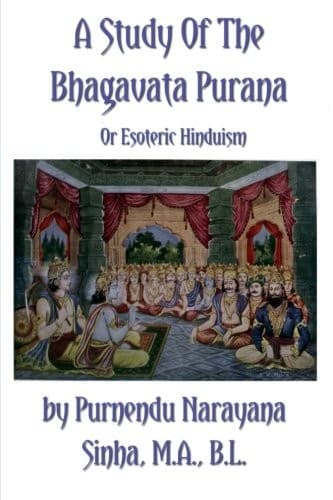
A Study of the Bhâgavata Purâna; or, Esoteric Hinduism
Religion
A Study of the Bhâgavata Purâna; or, Esoteric Hinduism
Puranas. Bhagavatapurana. English
"Consider Well the efforts of the deer. Concentrate _chitta_ into the
heart and all perceptions into _chitta_. Give up the company of woman.
Turn a deaf ear to all idle talks. Be devoted to that one true Friend of
Jivas — Îśvara. Retire, retire from all others."
King Prâchina Barhis wondered why such beautiful teachings were with
held by his teachers. Or forsooth, they knew not themselves. He
requested Nârada however to remove two doubts that were still lurking in
his mind. — Purusha acquires _karma_ in one body, but he reaps the
fruits of that _karma_ in another body. One body is the doer while
another is the enjoyer and sufferer. To one body, the fruits of its own
work are lost. To another body, there is an acquisition of fruits it did
not sow. How can this be? This was the first doubt.
What is done is done. Nothing apparently remains of our _karma_. How can
then the sequences be accounted for? This was the second doubt.
Narada replies: —
Purusha reaps the fruits in that very body without break in which it
acquires _karma_, but that body is the Linga Sarira, inclusive of Manas.
As in dream man works out the impressions of the wakeful state without
changing the body, so he enjoys the fruits of _karma_ created in one
birth in the Karma-made body of another birth.
And the doer of Karma is verily the Manas and not the Sthûla body.
"These are mine," "I am so and so," only such concepts of the mind
produce re-birth, and not anything in the Sthûla body. So the mind sows
and the mind reaps. The body is merely the vehicle of birth producing
thoughts.
This is in answer to the first question. Now to the second.
How do you know there is chitta or mind? All the senses are at one and
the same time in contact with the objects of all the senses. But still
you perceive only one thing at a time. Hence you infer the existence of
the mind. Similarly by marking the tendencies of the mind their
connection with a former birth is inferred. Otherwise why should there
be one mental affection at a time and not another?
Then, in this life you never realise a thing which you never heard or
saw or felt before. How can the mind then reproduce matters you never
experienced before?
The mind by its present characteristics gives an insight into the past
as well as into the future.
It sometimes happens that things are perceived in the mind with strange
combinations in time, space and action, as in dream.
But men are endowed with mind and the mind perceives one after another
the objects of the senses in an enormous variety, and the perceptions
are lost again. So (in the long run) not one experience is altogether
strange.
(For instance, a man sees in dream that he is a king. He must have been
a king in some birth or other. The present combination in the dream is
untrue but not so the kingly experience. The experience is always true
with reference to some time, some space, some action or other).
Public-domain text, read in full here on John Shaqi.
Reviews
Reviews
No reviews yet
Be the first to share your thoughts on this work.
Elsewhere in the archive
Join the Discussion
Join the discussion
Sign in to leave a comment or review.
Sign InorCreate an account