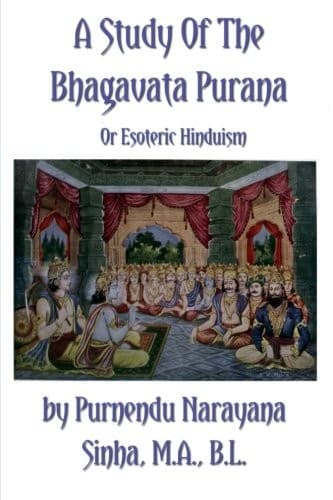
A Study of the Bhâgavata Purâna; or, Esoteric Hinduism
Religion
A Study of the Bhâgavata Purâna; or, Esoteric Hinduism
Puranas. Bhagavatapurana. English
Prajvâra is destructive fever.
As long as Purusha does not know his real self, but identifies himself
with the Gunas of Prakriti, he becomes subject to births and deaths. The
only remedy for this malady is pure devotion to Guru and to Bhagavân. By
such devotion, dispassion and wisdom are both acquired.
"Darbha" is Kusa grass, symbolical of Yajna. "Vidarbha" is pure land.
"Malaya" or the Deccan is famous for Vishnu worship.
"Malayadhvaja" is therefore a Vaishnava king.
[It appears that Vaishnavism had its rise and growth in the South of
India before it overspread Northern India. This would be natural
considering the hold of Vedic Brahmânism in Northern India.]
The daughter of Malayadhvaja is Devotion. The seven sons are the seven
divisions of Bhakti, viz. —
1) _Sravana_ or hearing the glory of Vishnu,
2) _Kirtana_ or reciting the glory of Vishnu,
3) _Smarana_ or constant remembrance of Vishnu,
4) _Pâdasevana_ or shewing respect to Vishnu,
5) _Archana_ or worship of Vishnu,
6) _Bandana_ or adoration of Vishnu,
7) _Dâsya_ or consecration of one self to the service of Vishnu.
The other two divisions, _Saukhya_ or companionship with Vishnu and
_Âtmâ nivedana_ or complete resignation are not mentioned in this
connection as they relate to a highly advanced spiritual state.
These modes of Bhakti worship are prevalent in Dravida.
The millions of sons are sub-divisions of Sravana, &c.
"Agastya" is mind.
"Dridhachyuta" is one confirmed in dispassion.
"Idhmavâha" is one who goes to Guru, fuel in hand, for instructions.
Iśvara, the unknown friend, called Himself and the Purusha two Kansas of
the Mânasa Lake. Hansa is one absolutely pure. Mânasa Lake is the Heart.
"For one thousand years" — Both Jiva and Iśvara remained together as
friends, the same in essence and in form, during the one thousand years
of Mahâ Pralaya, at the end of a Kaipa. During Manvantaric
Manifestation, the Jiva parts from his Friend Iśvara and launches into a
wild course of enjoyments, of joys and sorrows. The touch of that
fascinating lady Buddhi destroys all previous remembrances and the Jiva
plays several characters in the drama of life, in dream and delusion.
Nârada concluded his explanation of the allegory with this eloquent
exhortation: —
"Know thou, O King, the deer, skipping in the flower-garden, in company
with its sweet-heart, deeply attached to the sweets of that garden,
devouring with eager ears the humming music of _bhramaras_, little
caring for the wolves on its way or for the arrows of the huntsman that
pierce its back.
"The flowers are but women who bloom only to droop. The fragrance and
honey, the sweets of the garden, are the enjoyments brought on by the
_karma_ of another birth."
"The music of _bhramaras_ is the pleasing conversation of women and
others. The wolves are the days and nights. The huntsman who stealthily
flings arrows at the deer is Death. The deer is thy own self."
Public-domain text, read in full here on John Shaqi.
Reviews
Reviews
No reviews yet
Be the first to share your thoughts on this work.
Elsewhere in the archive
Join the Discussion
Join the discussion
Sign in to leave a comment or review.
Sign InorCreate an account