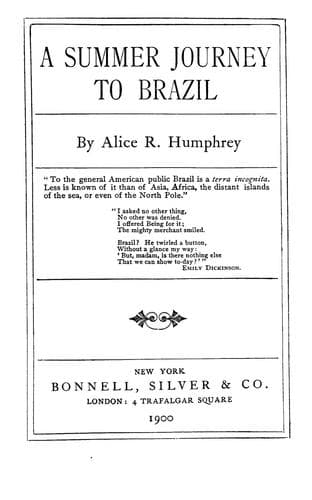
Brazil -- Description and travel; São Paulo (Brazil : State)
I remember well our anchoring in 1895, in the great bay--Bahia means
bay--surrounded by bluffs on which the bright-colored buildings of the
city show to fine advantage. The fleet of little boats rowed out the
mile to meet us. The Presbyterian missionary friends we had known so
pleasantly in our own land, the Chamberlains and the Kolbs, were in one
of them and we no longer felt unknown and far away.
Mr. Chamberlain said, “We came out to see you and Bishop Granbery.”
“The Bishop is not on this ship,” we replied. But persistent
investigation discovered him, his wife, and the Secretary of
the Foreign Mission Board of the Methodist Church South in the
“second-class.” The quarters located over the screw had kept them
miserable from the constant vibration and seasick the entire voyage, so
they were thoroughly used up.
Whoever has read “The Bishop’s Conversion”[2] will appreciate the
story. Most merchants “economize some other way.” There are differing
views of this economy among missionaries, and individual needs should
enter into the decision, but the nervous system should be strong to
endure the perpetual motion of the screw.
[2] Published by the Methodist Book Concern.
That half-day in Bahia harbor with our friends was a taste of missions
at short range. Their flourishing school had just closed. It was a
new venture with Miss Laura Chamberlain for principal. The last day
of school had been a memorable one, visited by parents who sent their
children with fear and trembling, but who came to see the ending with
pride and astonishment. The secular papers had commented unrequested
on the high quality of instruction--a brave deed there where
Protestantism had no friends. The Brazilian owner of a great factory in
a suburb had been present and proposed to pay the expenses of such a
school among his employees if “we” could provide such teachers. How we
all planned! How worth while it seemed to live! to plan schools for a
great state in which only sixteen in a hundred could read! even if it
were only for two schools, “ours” and the factory owner’s.
Mr. Chamberlain had just returned from his first long journey in the
saddle away, away into the interior of the state, and found material
for Gospel teaching which filled him with enthusiasm--the sturdy
“cowboys,” men clad in leather, of fine physique and stamina. “Rough
Riders” were not then renowned, but Mr. Chamberlain’s prophetic eye saw
his men as they might be and longed to get plenty of help and be at
work to realize the vision.
Public-domain text, read in full here on John Shaqi.
Reviews
Reviews
No reviews yet
Be the first to share your thoughts on this work.
Join the Discussion
Join the discussion
Sign in to leave a comment or review.
Sign InorCreate an account