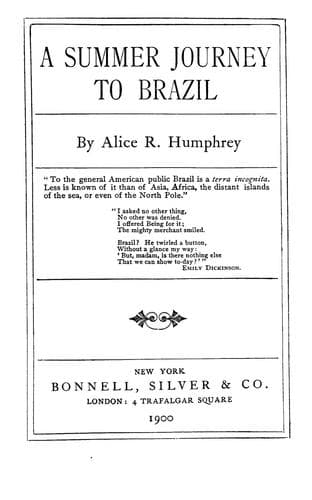
Brazil -- Description and travel; São Paulo (Brazil : State)
You go to see the National Art Gallery and find a few good pictures
of local feeling or history, but otherwise the work of artists who
have studied in Paris. You have climbed one precipice of five hundred
feet by the “Plano inclinado,” looked down over the brilliant city
flecked with palms, and followed the substantial aqueduct “built by
the Jesuits” long ago, which brings water into town from the heights,
over arches at first low, but rising about a hundred feet across one
valley. The masonry is stuccoed, moss-grown, fern-draped; the water
pure and refreshing. You ascend to the top of Corcovado, twenty-five
hundred feet high, by another cog-wheel railroad, and find a little
shelter-house at the peak from which you see the wonderful view of
city, bay, other mountains and ocean bathed in light; then hurry down
to get the “barca,” the large fine ferry-boat which takes you ten
miles across the bay on your way to Petropolis. It leaves at four in
the afternoon. How you love that sail in the soft air across that
beautiful bay! You look forward to the great Organ Mountains up which
you will soon be climbing, and wonder what harmonies came from those
giant fluted pipes when the morning stars sang together. You have good
company, English, German and American in addition to the Brazilian.
Too soon you are in the train which speeds along the few level miles,
then dismembers and climbs the heavy grade in sections. You will never
forget the outlook from these windows and wonder if so much beauty has
existed all these years known to so few.
PETROPOLIS.
Four thousand feet up, and back from all sight of the harbor, you
reach Petropolis, built first as the summer residence of the Emperor,
Dom Pedro, and named for himself. It is a beautiful town, the home of
rich Brazilians, foreign merchants and foreign legations, for it is
the diplomatic center. While you stay at the English Pensáo Honoria,
some ship-friends are near by at the Hungarian Pensáo Central, both
with unusually good food and service. In the garden great bushes of
the camelia are covered with waxen blossoms and the poinsettia blazes
beside a hedge of heliotrope. Humming-birds dart in and out among the
shrubs. Through the middle of every street runs the mountain stream in
a stone-curbed channel, spanned by Indian-red bridges at the street
crossings.
[Illustration]
Dom Pedro was the “village improvement society,” and the main street
is still called the “Rua Imperador” although it was renamed when he
was banished. The town follows the narrow valleys between hills always
green. The gardens are bewildering in their profusion of flowers.
Lilies blossom as they do in California. Orange trees perfume the air.
The verandas are but a step up from the ground, and the rooms open upon
the verandas. You feel little need for a house. Only hotels and palaces
are two stories high; the rest are one.
Public-domain text, read in full here on John Shaqi.
Reviews
Reviews
No reviews yet
Be the first to share your thoughts on this work.
Join the Discussion
Join the discussion
Sign in to leave a comment or review.
Sign InorCreate an account