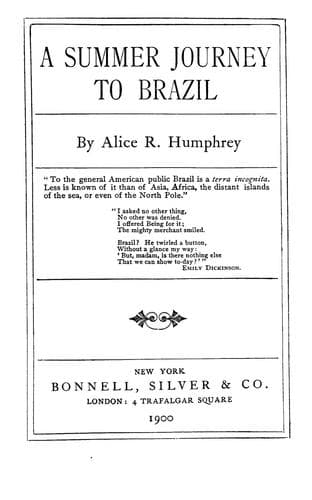
Brazil -- Description and travel; São Paulo (Brazil : State)
The business men are all at home, glad to rest one day in seven from
the three hours’ journey to their Rio offices and the three hours back,
besides their exciting markets. Through the week they have little
chance for exercise, for the only train down the mountain leaves at
seven in the morning, and one cannot reach home much before seven
at night. The early coffee has thoroughly wakened and fortified the
system against malaria. You see with what keen pleasure the various
parties start off on horseback or a-wheel. They will ride until they
are healthily tired and come back to be entertained in little groups
at hospitable boards. What will you do? accept the invitation and join
one of the groups? or stay in your own garden, and eat your own hotel
breakfast?
In any case you attend the service in the hall, in company with thirty
or forty others. Double this number in town are English or Americans.
One of the Methodist schoolteachers plays the harmonium. Moody and
Sankey hymns are sung. It is more nearly a piece of North America
than anything you have seen since you left that beloved spot, but the
setting is foreign, from the different wall-paper patterns to the very
wide boards of very hard wood which compose the bare floor, and the
foreign-looking houses you see through the window. Your missionary
preacher has held a Portuguese service, attended by the poor, in the
morning, and a collection keeps this English service self-supporting,
so far as room-rent goes.
You must make another trip to Rio. This time your first objective point
will be the Botanical Garden, with its magnificent alley of palms,
its more beautiful alley of bamboos, old tamarind trees and other
attractions. You will not be disappointed in the beauty, but you will
be surprised to find yourself there almost alone. The “bond” has taken
you through interesting streets, and quite a long distance on the edge
of the bay. You have skirted hills built to the top and others too
steep for that. You return to the heart of town in time for a late
breakfast, one o’clock, which you may have invited some friends to
share at a capital restaurant on “the Ouvidor.” You climb a long flight
of stairs to a large, cool, pleasant room with many open windows. Every
room by law must be at least fifteen feet high, whatever its floor
dimensions, and public rooms are always frescoed with old-time panels
and bunches of flowers.
What is the Ouvidor? A very narrow street, too narrow for vehicles,
lined on both sides for seven or eight blocks with the best stores
of Rio. It is also a meeting-place for politicians and newsmongers,
gentlemen of leisure and fashion.
When I went to Rio first in 1884 it was not proper for a woman to go in
the street without some man to take care of her. She certainly could
not go to shop alone in the Ouvidor as she sometimes does now.
Public-domain text, read in full here on John Shaqi.
Reviews
Reviews
No reviews yet
Be the first to share your thoughts on this work.
Join the Discussion
Join the discussion
Sign in to leave a comment or review.
Sign InorCreate an account