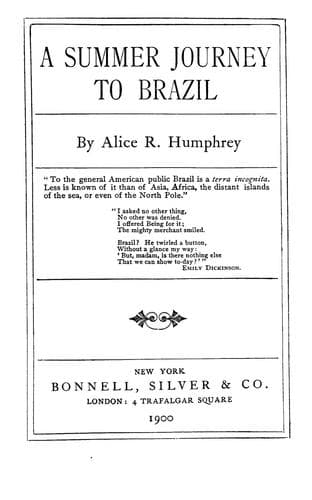
Brazil -- Description and travel; São Paulo (Brazil : State)
It will always be a pleasure to remember the hospitality of both
merchants and missionaries. Before leaving São Paulo, you must
accept the offer of Dr. Lane, President of Mackenzie College, to go
through not only his own preparatory classes and college, where you
will find the first working laboratory for chemistry in a Brazilian
school and the first manual training school, as well as plenty of
classic Portuguese, Latin, and other things, but go through the
Government schools as well, where he is always an honored guest. Then
go to Cantareira with Prof. Orville A. Derby, the eminent Government
geologist, and the young professors of the college. It is an easy day’s
excursion to the source of the water supply for the city. A train of
open cars takes you through old gardens of roses, and out to the
mountain streams, enclosed by first-rate engineering, and filtered and
reservoired amid gardens and masonry most attractive. You can study a
coffee-tree (or bush) of your own height, with shiny green leaves and
bright red cherries, the pits of which are two coffee-beans lying with
their flat sides together, and recall the enthusiastic description of a
man who has just returned from a trip to a great coffee plantation in
the interior.
“As one rides on horseback between the rows of coffee-trees his head
is hardly visible above them. Call to mind the hedgerows of England,
stretch them in straight, long lines with just room between for the
pickers. A space twenty-five feet wide between every hundred rows is a
road for carts, but there are no cross streets. Starting from the edge
of the fazenda (plantation) quite rapid riding for two hours brings one
to the center view from a dome-shaped hill. In all directions as far
as the eye can see there is nothing but coffee trees. The only visible
ground is the deep red earth of the streets separating each hundred
rows. It is a rolling prairie of living green, on a colossal scale. Two
months earlier the blossoms covered it ‘like a white sheet.’ A little
later this green will be brilliant with red cherries, the branches
heavily weighted down by the fruit. This fazenda has 1,600,000 bearing
coffee trees. The next has nearly 4,000,000 trees and is the largest
in the world. Now I understand how this State produces more coffee
even in a bad year than all the rest of the world outside of Brazil
combined. Its possibilities in a good year are nearly double the crops
other than those of Brazil. The quality is altogether finer than that
known in the United States as Rio. This is what has brought English
and German capital, increased the population of the city of São Paulo
to 200,000 from 60,000 in 1884, and made the commerce of Santos what
it is. Italians and Germans both work on these plantations and the one
I have just described, which I have just visited, has fifteen hundred
people living on the fazenda and constantly employed. The larger
plantation, ‘the Fazenda Dumont,’ had a railroad of some twenty miles
Public-domain text, read in full here on John Shaqi.
Reviews
Reviews
No reviews yet
Be the first to share your thoughts on this work.
Join the Discussion
Join the discussion
Sign in to leave a comment or review.
Sign InorCreate an account