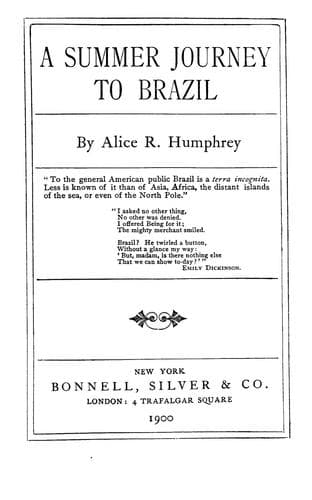
Brazil -- Description and travel; São Paulo (Brazil : State)
THAT FAMOUS SCENE AT RIO, WHEN THE DETROIT THREATENED TO SINK TWO OF
GAMA’s SHIPS.
Rio de Janeiro, Feb. 8, 1894.--The first gun fired with warlike intent
by an American war ship at another ship within thirty years was fired
from the Detroit early on the morning of January 29 at the insurgent
Brazilian ship Trajano in this harbor. A second shot was fired a few
minutes later at the Guanabara, another insurgent Brazilian lying not
far from the one first assaulted. Some of the facts of this incident
were told in _The Sun_ on the next day after they occurred, but the
whole story will be found of interest even at the date when this can
be published after transmission to New York by mail.
The trouble which made the firing necessary arose unexpectedly early in
the last week of January. For some time before that date Admiral Gama,
the insurgent leader, had been in communication with Admiral Benham
with a view of enlisting the services of the American Admiral as a
mediator in compromising the fight that had been wasting the substance
of the nation for more than four months. So far as any one could see,
Gama was sincere in saying that he desired peace and would make all
honorable concessions to obtain it. Peixoto’s Government was notified
of these negotiations, and in answer a promise to submit propositions
for peace was obtained. But before the Government had had sufficient
time for deliberation in the matter several Captains of American
merchant vessels made application to Admiral Benham for protection from
the fire of the insurgents while en route to the piers to discharge
cargoes. The insurgents had notified the merchantmen that if they
attempted to go to the piers to discharge cargo they would be fired
upon.
This matter was brought to the attention of Gama when, as a private
citizen, he called on Benham to talk over the propositions for
compromise. Gama explained his position at length. He did not wish, he
said, to prevent the American ships from discharging their cargoes;
he wanted only that they discharge into lighters while moored in
the bay in order that he might inspect their cargoes and search for
munitions of war destined for the Government. He added that this
right had been conceded to him by all the foreign naval commanders
theretofore--Captain Lang, the British senior officer, Captain Picking,
the American senior officer before Benham’s arrival, and others, had
united in prohibiting the landing of even a search-light intended for
Government use, and the machine had in consequence been sent around to
Santos and landed. Gama, in short, claimed the right to blockade the
port of Rio on the ground that he was the Brazilian master afloat--that
the Government could not function to any extent whatever on the waters
of the bay.
Public-domain text, read in full here on John Shaqi.
Reviews
Reviews
No reviews yet
Be the first to share your thoughts on this work.
Join the Discussion
Join the discussion
Sign in to leave a comment or review.
Sign InorCreate an account