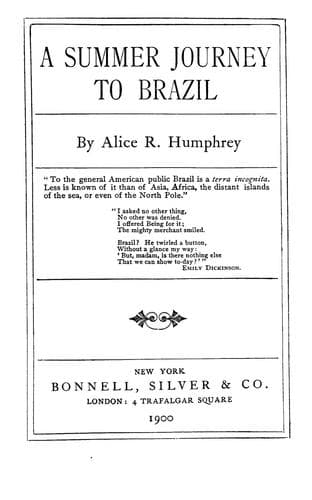
Brazil -- Description and travel; São Paulo (Brazil : State)
Of the British backers more will be told at another time, but there
was one man mentioned in the cable of whom something should be said
now. This is G. M. Rollins of New York. Rollins has been a mystery to
the English-speaking people of the port. He came here on the steamer
“Wordsworth” about December 1. He lived on the “Wordsworth” for a
time, and then moved to the “Vandyke,” a hulk owned by the Lamport &
Holt line, and used as a warehouse. Here he lived with “the manager
off shore” of the line. In some way he got acquainted with Gama and
the two became good friends. It was on this account that Gama opened
negotiations for a compromise with the Government through Admiral
Benham. When people learned this, there were many wild conjectures
about Rollins. These conjectures were the wilder because Rollins did
not choose to tell people why he came here, and, further, because he
said he was authorized by Mr. Taylor of the New York _Herald_ to send
letters to that paper, while the _Herald’s_ special representative
published a note in _O Paiz_ saying that Rollins was a fraud.
Rollins tried to get the American barks to remain out in the bay, and
promised them the free use of a tug and lighters if they would do so.
At first they agreed to this, but afterward went to the piers. Rollins
would have supplied Lamport & Holt lighters and tugs had they remained,
and it is guessed that Gama would have paid the bill through Rollins.
To fully understand the result of Admiral Benham’s action it should be
said that until the “Detroit” opened the way the port was practically
blockaded to all commerce save that of the regular liners. Ships had
been lying in port four months, waiting opportunity to discharge and
load. Gama had all of the tugs of the harbor, save two belonging to the
Lamport & Holt line, one to Wilson, Sons & Co., one under the German
flag, and one that was captured by the British naval fleet when Boyton
tried to blow up the “Aquidaban” with it. This last was used as a
British war-ship tender, but occasionally towed a merchant ship. The
line’s tugs were naturally to be had by other ships, but rarely and at
high prices. Lighters were equally scarce. Gama would not let the ships
go to the piers, and was in this supported by the foreign war ships so
long as Captain Lang of the British ship “Sirius” dominated the foreign
fleet.
Public-domain text, read in full here on John Shaqi.
Reviews
Reviews
No reviews yet
Be the first to share your thoughts on this work.
Join the Discussion
Join the discussion
Sign in to leave a comment or review.
Sign InorCreate an account