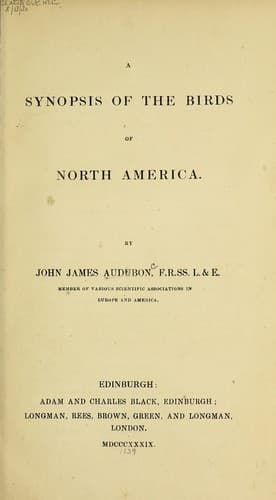
A Synopsis of the Birds of North AmericaAudubon, John James
Science
A Synopsis of the Birds of North America
Audubon, John James
Birds -- Classification; Birds -- North America
Bill thick; second and third quills equal, first little shorter. Male
with the upper part of the head black, the back and scapulars
yellowish-green, faintly streaked with dusky, the rump inclining to
greenish-yellow; the wings and tail black; the former, when extended,
crossed by two bands, one greenish-yellow, tipping the first row of
small coverts, the other bright yellow and broad at the base of the
primary and secondary quills; tail also yellow in its basal third,
except on the middle feather; lower parts greenish-yellow, feeding
into white on the abdomen; feathers on the throat black at the base;
lower tail-coverts yellow, tipped with white, and having a central
dusky streak. Female dull yellowish-green above, faintly streaked with
dusky, paler beneath.
In this species, which I have named in honour of the illustrious Earl
of Derby, the bill is so thick and short as to approach in form to
that of the European Greenfinch.
_Male_, 4-9/12, wing, 2-10/12.
Upper California.
GENUS IX. FRINGILLA, Linn. FINCH.
Bill short, stout, conical, somewhat compressed, pointed; upper
mandible of the same breadth as the lower, with its dorsal line
straight, the ridge indistinct, the sides rounded, the edges ascending
at the base, the notches obsolete, the tip scarcely deflected; lower
mandible with the angle very short and rounded, the dorsal line
straight, the sides convex, the edges inflected, the tip acute.
Nostrils basal, roundish, concealed by the feathers. Head rather
large, ovate; neck short; body compact. Legs of moderate length;
tarsus rather short, compressed, with seven scutella; toes moderate;
hind toe stout, lateral equal. Claws rather long, arched, compressed,
acute. Plumage rather compact, but blended. Wings of moderate length,
with the second, third, and fourth quills longest. Tail of moderate
length, slightly emarginate. Roof of upper mandible moderately
concave, with three longitudinal ridges; tongue compressed, channelled
above, horny, rather obtuse and concave at the end; œsophagus
dilated about the middle; stomach roundish, muscular; intestine rather
short; cœca small.
* Wings rather short, claws long, little arched.
186. 1. Fringilla iliaca, Merrem. Fox-coloured Finch.
Plate CVIII. Male and Female.
Upper parts light red, claws long, hind toe and its claws of equal
length, tail lighter, the head and neck intermixed with light
bluish-grey; inner webs of quills brown, secondary coverts slightly
tipped with whitish; lower parts white, and, except the abdomen,
spotted with light red, the spots on the breast smaller and inclining
to black; a patch of dusky on its fore part, produced by the inner
webs of several of the feathers.
_Male_, 7-1/2, 10-1/2. _Female_, 7-1/2.
Dispersed in winter throughout the Southern and Western Districts.
Breeds from Nova Scotia to Labrador and the Fur Countries. Rather
common.
Fox-coloured Sparrow, Fringilla rufa, Wils. Amer. Orn. v. iii.
p. 53.
Public-domain text, read in full here on John Shaqi.
Reviews
Reviews
No reviews yet
Be the first to share your thoughts on this work.
Elsewhere in the archive
Join the Discussion
Join the discussion
Sign in to leave a comment or review.
Sign InorCreate an account