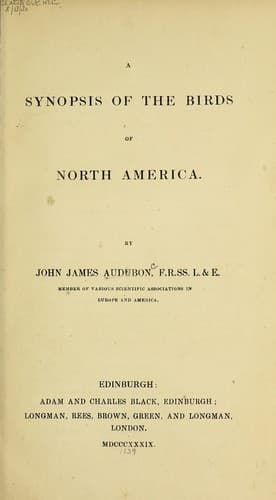
A Synopsis of the Birds of North AmericaAudubon, John James
Science
A Synopsis of the Birds of North America
Audubon, John James
Birds -- Classification; Birds -- North America
First quill longer than fifth, the intermediate quills almost equal.
Male with the upper part of the head, the hind neck, and the anterior
portion of the back, with the loral space, some feathers at the base
of the lower mandible, and a rather narrow longitudinal band on the
fore neck, deep black; anterior part of the forehead, a band over the
eye, the cheeks, sides of the neck, and the breast, rich
orange-yellow, the rest of the lower parts paler; lower wing-coverts
and anterior edge of the wing pale yellow; hind parts of the back and
upper tail-coverts yellow tinged with green; wings brownish-black,
with a large patch of white formed by the outer small coverts and the
edges of the secondary coverts; quills edged with white; four middle
tail-feathers black, the rest orange-yellow, with a dusky patch near
the end. Female smaller, with the upper parts greyish-olive, lighter
on the rump; on the head and upper tail-coverts tinged with yellow;
loral space somewhat dusky; anterior part of the forehead, a band over
the eye, the cheeks, and sides of the neck, with the fore part of the
breast, light greenish-yellow; throat dull white, the rest of the
lower parts greyish-white, slightly tinged with yellow; wings dark
brown, the larger small coverts tipped with greyish-white; secondary
coverts and quills edged with the same; tail dull olivaceous-yellow.
Young like the female.
_Male_, 7-1/4, wing, 4-1/12.
Rocky Mountains, Columbia River, and California. Common. Migratory.
Xanthornus Bullockii, Swains. Syn. of Mex. Birds, Phil. Mag.
1827, p. 436.
Bullock's Troopial, Icterus Bullockii, Aud. Orn. Biog. v. v.
p. 9.
219. 3. Icterus spurius, Gmel. Orchard Hangnest.--Orchard Oriole.
Plate XLII. Male, Female, and Young.
Tail much rounded. Male with the head, neck, and fore part of the
back, black; the rest of the body chestnut-red; quills and larger
coverts black, the former margined, the latter tipped with
greyish-white; tail-feathers black, tipped with dull white. Female
with the head and upper parts dull yellowish-green, the fore part of
the back tinged with brown; lower parts pale yellow; wings and tail
greyish-brown, the feathers of the former margined with greyish-white,
of the latter with yellowish-green. Young, like the female. Young
males in various stages variously coloured.
_Male_, 6-1/2, 9.
From Texas to Connecticut, over the valley of the Mississippi,
Kentucky, and Ohio. Abundant. Rare in Massachusetts and Maine.
Missouri to the bases of the Rocky Mountains. Migratory.
Orchard Oriole, Oriolus mutatus, Wils. Amer. Orn. v. i. p. 64.
Icterus spurius, Bonap. Syn. p. 51.
Spurious or Orchard Oriole, Icterus spurius, Nutt. Man. v. i.
p. 165.
Orchard Oriole, Icterus spurius, Aud. Orn. Biog. v. i. p. 221;
v. v. p. 485.
GENUS V. QUISCALUS, Vieill. CROW-BLACKBIRD.
Public-domain text, read in full here on John Shaqi.
Reviews
Reviews
No reviews yet
Be the first to share your thoughts on this work.
Elsewhere in the archive
Join the Discussion
Join the discussion
Sign in to leave a comment or review.
Sign InorCreate an account